ADHD Explained: Symptoms, Causes and Support in Nigeria
ADHD Explained: Understanding Attention Deficit Hyperactivity Disorder
A bright child keeps “forgetting” homework that took hours to finish. A capable adult misses a third deadline and quietly wonders what is wrong with them. A parent in Lagos is told their son is simply “stubborn” or “not serious.” In many homes across Nigeria, these moments are read as character flaws. Sometimes they are signs of ADHD, one of the most common and most misunderstood brain conditions in the world.
ADHD stands for Attention Deficit Hyperactivity Disorder. It affects roughly 8 in every 100 children and adolescents globally, and it does not vanish at age 18. Yet most people who have it never get a name for what they are living with. This article is the starting point for HubPharm’s ADHD series, written to help patients, parents, and families who care for loved ones, including those doing it from across the diaspora.
What ADHD Actually Is
ADHD is a neurodevelopmental condition. That phrase simply means the brain develops and works a little differently from the typical pattern, starting in childhood. It is not caused by bad parenting, too much sugar, or watching screens. It is a real difference in how the brain manages attention, activity, and impulse.
The condition has three core features: trouble holding attention, restlessness or hyperactivity, and acting before thinking, known as impulsivity. A person does not need all three to have ADHD, which is part of why it is missed so often.
What surprises most people is how strongly ADHD is inherited. Studies estimate that genes account for somewhere between 70 and 80 percent of the risk. If a parent has it, a child often carries it too. That is how ADHD moves quietly through families, generation after generation, undiagnosed.
How ADHD Affects the Brain
Think of the brain as having a manager. That manager decides what to focus on, what to ignore, when to start a task, and when to stop. Scientists call this set of skills “executive function.” In ADHD, the manager is present and capable but works unevenly.
Much of this comes down to brain chemistry. Two chemical messengers, dopamine and norepinephrine, help regulate attention, motivation, and reward. In ADHD brains, these signalling systems behave differently, which affects the networks that control focus and self-control.
This is why a person with ADHD can play a video game or read about a passion for hours, then completely stall on a boring email. The brain’s reward system responds strongly to things that feel urgent, new, or interesting, and struggles with things that feel dull, even when those dull things matter most.
Why ADHD Is More Than Being Distracted
Calling ADHD “being easily distracted” is like calling diabetes “liking sweets.” It misses the real picture.
People with ADHD often face emotional intensity, difficulty managing time, forgetfulness, trouble finishing what they start, and a restless mind that rarely switches off. Many describe feeling like they are working twice as hard as everyone else just to keep up. The struggle is not about effort or intelligence. It is about a brain that handles regulation differently.
The ADHD Spectrum and Its Three Presentations
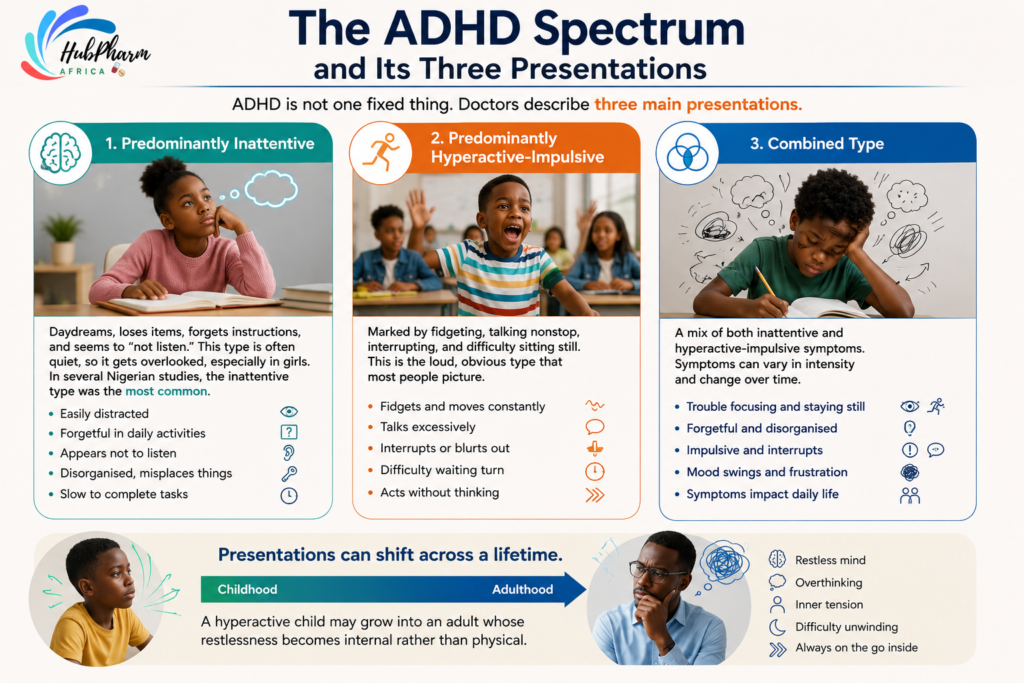
ADHD is not one fixed thing. Doctors describe three main presentations.
The first is predominantly inattentive, where a person daydreams, loses items, forgets instructions, and seems to “not listen.” This type is often quiet, so it gets overlooked, especially in girls. In several Nigerian studies, the inattentive type was the most common.
The second is predominantly hyperactive-impulsive, marked by fidgeting, talking nonstop, interrupting, and difficulty sitting still. This is the loud, obvious type that most people picture.
The third is the combined type, which mixes both. Presentations can also shift across a lifetime. A hyperactive child may grow into an adult whose restlessness becomes internal rather than physical.
ADHD in Children Versus Adults
In children, ADHD usually looks like trouble at school, constant movement, and difficulty following rules. In adults, it changes shape. The visible hyperactivity often fades, while inattention and disorganisation tend to stay.
Adult ADHD shows up as chronic lateness, unpaid bills, abandoned projects, impulsive spending, job-hopping, and strained relationships. Around 2 to 3 percent of adults worldwide live with it, and most have carried it since childhood without ever being told.
A key point for diagnosis: even when found in adulthood, the signs must have started early, before age 12. Put simply, ADHD is something you grow up with, not something you suddenly catch.
Common Signs and Symptoms
No two people with ADHD look exactly alike, but familiar patterns appear again and again. Difficulty starting or finishing tasks. Losing keys, phones, and documents. Zoning out during conversations. Blurting things out. Feeling restless or bored quickly. Struggling with deadlines despite caring deeply about the outcome. Emotional ups and downs that feel hard to control.
Everyone has some of these moments. The difference with ADHD is that the symptoms are frequent, last for months, show up in more than one area of life such as home and work, and genuinely get in the way.
Why So Many People Stay Undiagnosed
The diagnostic criteria doctors first used for ADHD were built mostly around young, visibly hyperactive boys. That bias alone has left millions of girls, women, and quiet inattentive children undetected for years.
Clever children also “mask.” They build coping tricks, lean on routine, and push through, which hides the struggle until life gets harder in university, at work, or in marriage. Diagnoses among adults over 30 have been climbing sharply in recent years as awareness grows. Many of these adults are not newly developing ADHD. They are finally being seen.
ADHD in Nigeria and Africa
ADHD is not a Western invention. Nigerian research has measured it for years. Studies of primary school pupils have reported rates near 8.7 percent, with later work in adolescents finding 8.8 percent. Other Nigerian studies land a little lower, which is normal, since results shift with the screening method used. Either way, our numbers sit comfortably within the global range.
The challenge is not whether ADHD exists here. The challenge is recognition. Nigeria has very few child psychiatrists for a population of over 200 million. Many teachers and parents have never heard the term. Children who cannot sit still are labelled rude or lazy, and the real issue goes untreated. For diaspora families supporting relatives back home, this gap is painful, since spotting the signs from abroad and finding qualified local help is rarely simple.
Stigma and Public Perception
In many Nigerian communities, behaviour problems carry shame. Some families fear a mental health label, worry about spiritual causes, or avoid medicines they do not understand. ADHD medicines in particular are controlled substances, which adds hesitation.
Silence has a cost. Untreated ADHD raises the risk of poor school outcomes, accidents, money troubles, and low self-esteem. Naming the condition is not a weakness. It is the first step toward support that actually works.
The Strengths That Often Come With ADHD
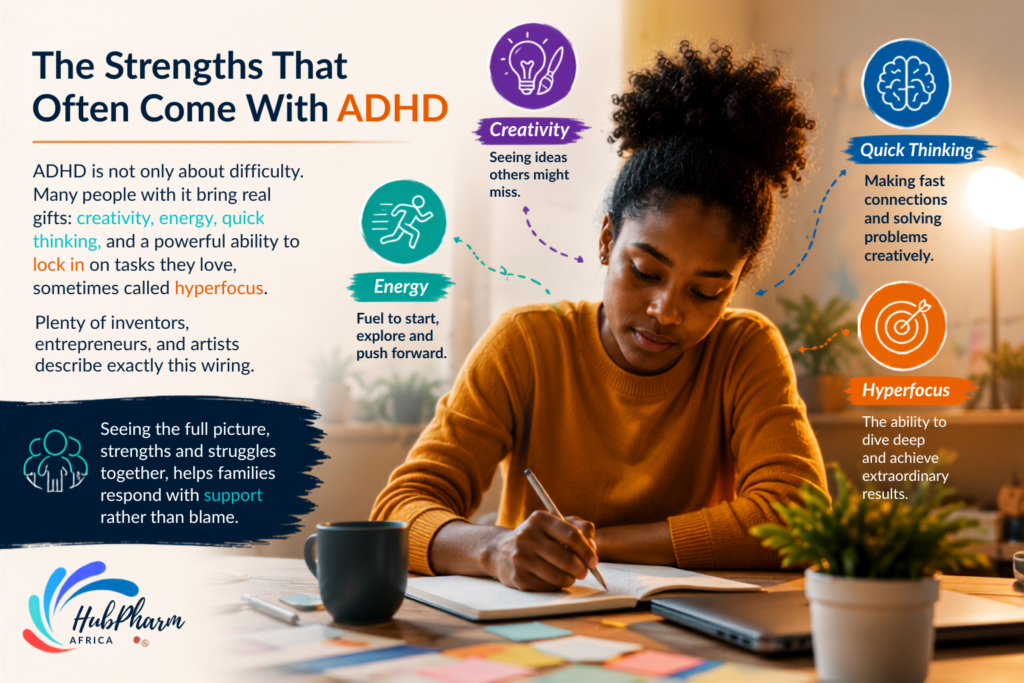
ADHD is not only about difficulty. Many people with it bring real gifts: creativity, energy, quick thinking, and a powerful ability to lock in on tasks they love, sometimes called hyperfocus. Plenty of inventors, entrepreneurs, and artists describe exactly this wiring. Seeing the full picture, strengths and struggles together, helps families respond with support rather than blame.
How ADHD Is Diagnosed
There is no single blood test or brain scan that confirms ADHD. Diagnosis comes from a trained professional, usually a psychiatrist, paediatrician, or clinical psychologist, who reviews symptoms across the person’s life.
The process typically involves detailed interviews, questionnaires for parents and teachers in the case of children, and a careful history that confirms symptoms began in childhood. The clinician also rules out other explanations such as anxiety, sleep problems, thyroid issues, or learning difficulties, since these can look similar. A proper assessment takes time and should never be rushed.
Common Myths About ADHD
| MYTH | REALITY |
| ADHD is just an excuse for bad behaviour. | ADHD is a recognised medical condition with measurable differences in brain chemistry and structure. It is no more an “excuse” than asthma or short sightedness. |
| Only hyperactive boys have ADHD. | The quiet, inattentive type is very common and often hits girls and women hardest. Many are diagnosed only in adulthood |
| Children outgrow ADHD. | For many people, symptoms continue into adult life, even if they change form. |
| ADHD is caused by sugar, screens, or poor discipline. | The strongest driver is genetics, not diet or parenting style. |
| ADHD medicines turn children into zombies or addicts. | When prescribed and monitored properly by professionals, treatment is well studied and helps many people function better. The dangers come from self-medication and fake products, not from supervised care. |
Medication Management
Medicines are one part of ADHD care, alongside behaviour strategies and lifestyle support. We will go deep on this in a dedicated ADHD medication guide, so here we keep it high level.
Treatment generally falls into two groups. Stimulant medicines, such as those based on methylphenidate, are the most studied and most commonly used. Non-stimulant options, including atomoxetine and certain others, are alternatives for people who cannot use stimulants. These are prescription-only medicines and must be chosen by a qualified prescriber.
A few principles protect anyone on treatment. Adherence matters, meaning the medicine is taken exactly as directed rather than skipped or doubled. The most common mistakes are stopping suddenly, sharing pills with others, or buying from unverified sellers, which in Nigeria carries a real risk of fake or substandard products. Medicines should be stored safely, away from children and out of heat and damp. And no one should start, stop, or adjust an ADHD medicine without speaking to a doctor or pharmacist first.
This is where a trusted pharmacy makes a difference. HubPharm Africa connects patients to genuine, verified medicines and to qualified pharmacists who can answer questions, check for interactions, and support adherence. If you have a prescription, you can reach a HubPharm pharmacist on WhatsApp, or call +234 705 050 5001 or through hubpharmafrica.com. Please treat the medicine examples here as education only. Any ADHD medicine should be used strictly under professional guidance.
Simple Ways to Support an ADHD Brain Starting Today
- Build routines and keep keys, bags, and documents in the same fixed spot every day.
- Break big tasks into small, timed steps and reward finishing each one.
- Use alarms, calendars, and phone reminders as an external memory, not as a sign of failure.
- Protect sleep, since tiredness makes attention and mood far worse.
- Move your body regularly, because exercise genuinely helps focus and calm.
- Replace blame with curiosity when a child struggles, and ask a professional rather than guessing.
- If symptoms are disrupting school, work, or relationships, book an assessment instead of waiting it out.
Frequently Asked Questions
What is ADHD in simple terms? ADHD is a brain-based condition that makes it harder to manage attention, activity, and impulses. It starts in childhood and often continues into adult life.
What are the main signs of ADHD? Trouble focusing, forgetfulness, restlessness, acting without thinking, disorganisation, and difficulty finishing tasks that last for months and affect more than one part of life.
Can adults have ADHD if it was never diagnosed as a child? Yes. Many adults have had ADHD all along and are only recognised later in life, though the symptoms must trace back to before age 12.
Is ADHD common in Nigeria? Yes. Nigerian studies have found ADHD in roughly 5 to 9 percent of school children, similar to global figures. The main problem is that it often goes unrecognised.
Is ADHD caused by bad parenting or too much sugar? No. Genetics is the strongest factor. Diet and parenting can affect behaviour but do not cause ADHD.
Can ADHD be cured? There is no cure, but it can be managed very well with the right mix of professional support, strategies, and where needed, medicine.
Who can diagnose ADHD? A trained professional such as a psychiatrist, paediatrician, or clinical psychologist, after a careful assessment.
A Final Word
ADHD is common, real, and far more than simply being distracted. It is a difference in how the brain handles attention and self-control, shaped largely by genes, and it touches children and adults alike, in Nigeria as everywhere else. If any part of this felt like reading about yourself or someone you love, that recognition is not a verdict. It is an opening.
You are not lazy, broken, or beyond help. With the right understanding, support, and care, people with ADHD live full, productive, often remarkable lives. The next step is simple: learn more, talk to a professional, and lean on people who can help you do it safely. HubPharm Africa is one of them.
Author
Kelvin is a Physiology graduate from the prestigious University of Ilorin, with a background spanning health science, therapy, and health communications. As Content creation Lead at HubPharm Africa, he brings a science-informed perspective to making health information accessible, accurate, and engaging. You can share your perspectives and/or feedback with Kelvin at kelvin@hubpharmafrica.com