PrEP in Nigeria: Do You Need It If You Have Multiple Partners?
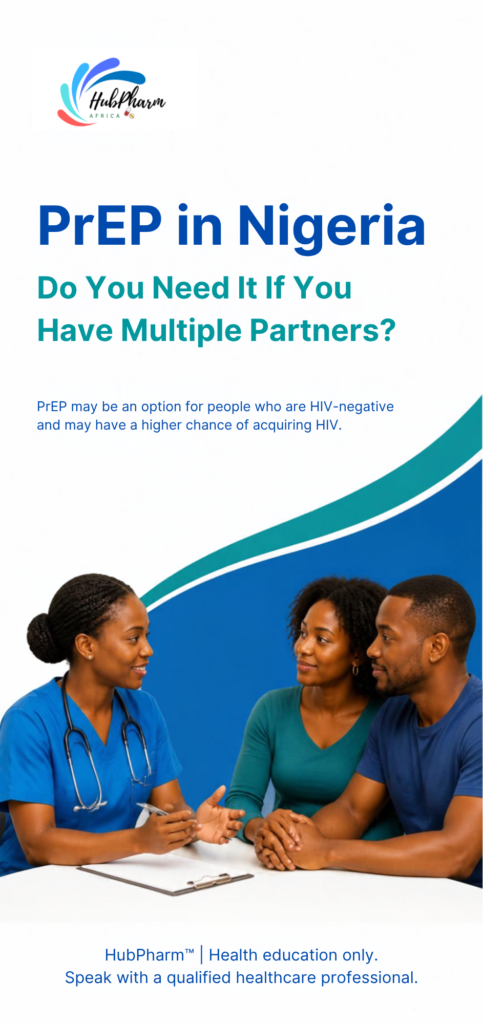
Having more than one sexual partner does not automatically mean that someone has HIV or needs PrEP. However, having multiple partners can increase the chance of encountering HIV, especially when partners’ HIV status is unknown or condoms are not used consistently.
Pre-exposure prophylaxis (PrEP) is one option that can help HIV-negative people reduce their risk of acquiring HIV.
WHO recommends PrEP as an additional prevention choice for people who have a substantial risk of HIV infection. Current WHO guidance also considers having sex without condoms with more than one partner as one sign that PrEP may be appropriate.
What Is PrEP?

PrEP is an HIV-prevention medicine for people who do not have HIV.
When taken correctly, PrEP can provide a high level of protection against HIV. It forms part of combination HIV prevention, which can also include condoms, HIV testing and treatment of people living with HIV.
PrEP does not treat an existing HIV infection.
Therefore, anyone considering PrEP needs an HIV test and appropriate clinical assessment before starting.
Does Having Multiple Partners Mean You Need PrEP?
Not necessarily.
The number of partners alone does not determine whether PrEP is appropriate. Instead, healthcare professionals consider the person’s overall likelihood of HIV exposure.
Factors that may make PrEP worth discussing include:
- Having more than one sexual partner
- Having sex without condoms
- Difficulty using condoms consistently
- Having a partner whose HIV status is unknown
- Having a sexual partner with HIV who is not known to have a suppressed viral load
- Having recently had an STI
- Repeatedly needing PEP after potential HIV exposure
WHO’s HIV decision-support guidance specifically identifies sex without a condom with more than one partner in the previous six months as a sign that PrEP may be suitable for an HIV-negative person after appropriate assessment.
The goal is not to judge someone’s relationships. Instead, PrEP gives people another way to reduce HIV risk.
What If You Always Use Condoms?
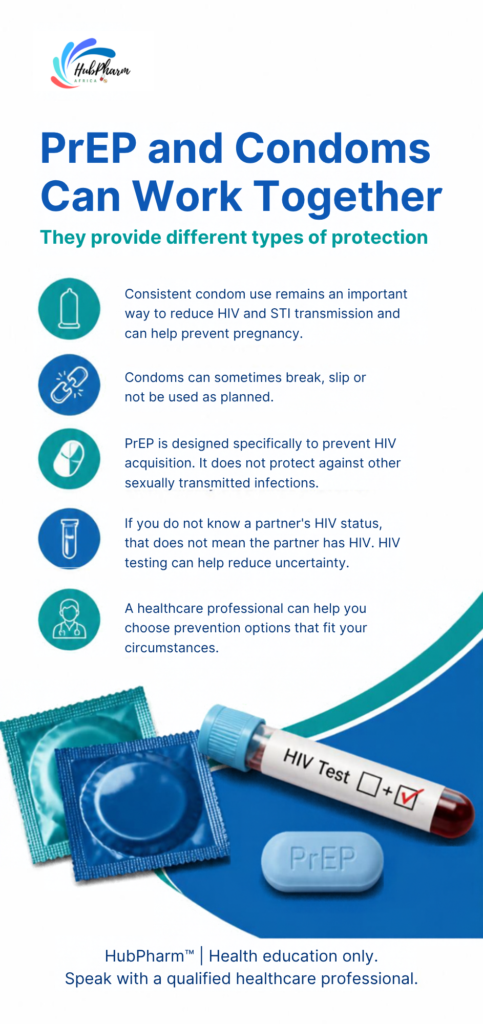
Consistent condom use remains an important way to reduce HIV and STI transmission.
However, condoms can sometimes break, slip or not be used as planned. Some people may also find consistent condom use difficult in certain relationships or circumstances.
For someone who wants additional protection against HIV, PrEP can provide another prevention option.
Importantly, PrEP does not protect against other sexually transmitted infections. Condoms can still provide protection against many STIs and can also help prevent pregnancy.
For this reason, PrEP and condoms can work together rather than being competing choices.
What If You Do Not Know Your Partner’s HIV Status?
An unknown HIV status does not mean that a partner has HIV.
However, when you do not know a partner’s status, you cannot use that information to assess your HIV risk.
HIV testing can help remove that uncertainty. If your circumstances suggest a substantial risk of HIV exposure, a healthcare professional may also discuss PrEP with you.
WHO recommends HIV testing as part of PrEP services, alongside appropriate clinical assessment and follow-up.
PrEP and HIV Testing
Before starting PrEP, you need to establish that you do not have HIV.
This is important because PrEP is designed for HIV-negative people. Someone who already has HIV needs appropriate HIV treatment rather than PrEP alone.
Regular HIV testing also forms an important part of ongoing PrEP care.
Testing can therefore help you and your healthcare professional make informed decisions about continuing prevention.
How Effective Is PrEP?
PrEP is highly effective when people use it as recommended.
However, it does not provide a reason to ignore other prevention measures or medical follow-up.
Taking PrEP correctly, attending recommended appointments and completing HIV testing all contribute to effective prevention. WHO describes oral PrEP as highly effective when used as directed.
Your healthcare professional can explain which PrEP option is appropriate for you and how it should be used.
What If You Stop Having Multiple Partners?
Your HIV risk can change over time.
For example, you may enter a mutually monogamous relationship, learn that your partner is HIV-negative, or have a partner living with HIV who maintains an undetectable viral load.
In other situations, your risk may increase again.
WHO guidance recognises that people may start and stop PrEP depending on periods of higher and lower HIV risk. However, decisions about stopping or restarting PrEP should follow appropriate clinical guidance.
This makes PrEP different from medicines that someone necessarily needs every day for the rest of their life.
What If You Recently Had a Possible HIV Exposure?
PrEP and PEP are not the same.
PrEP helps prevent HIV before potential exposure.
PEP, or post-exposure prophylaxis, is an emergency prevention option used after a possible HIV exposure.
If you think you have recently been exposed to HIV, seek medical care promptly rather than assuming that PrEP is the appropriate response.
WHO guidance recommends considering PEP for eligible people after a possible exposure, while people with continuing substantial risk may later transition to PrEP.
Our upcoming article on HIV PEP after a potential exposure will explain this in more detail.
Are There Side Effects From PrEP?
Like other medicines, PrEP can cause side effects in some people.
Some people may experience mild symptoms such as nausea, abdominal discomfort or headache when they first start oral PrEP. WHO notes that these symptoms are generally mild and tend to resolve.
Your healthcare provider can also consider your health history and other medicines before recommending a PrEP option.
If you develop concerning symptoms or have questions about your medicine, speak with a healthcare professional rather than stopping treatment without advice.
PrEP Is Not a Judgment About Your Lifestyle
This is important.
Choosing PrEP does not mean someone is irresponsible, promiscuous or infected with HIV.
People have different relationships, circumstances and levels of HIV exposure. PrEP simply provides another prevention choice for people who may benefit from it.
WHO states that the decision to use PrEP should ultimately be made by the individual after receiving appropriate information and support.
PrEP in Nigeria
Nigeria’s current national HIV guidelines include PrEP as an important HIV-prevention intervention. The 2026 national guidelines also describe prevention approaches for people whose circumstances may increase their risk of HIV exposure.
PrEP services can involve HIV testing, assessment, counselling and follow-up rather than simply receiving a medicine.
Therefore, speaking with an appropriately trained healthcare professional is an important part of starting PrEP.
When Should You Talk to a Healthcare Professional?
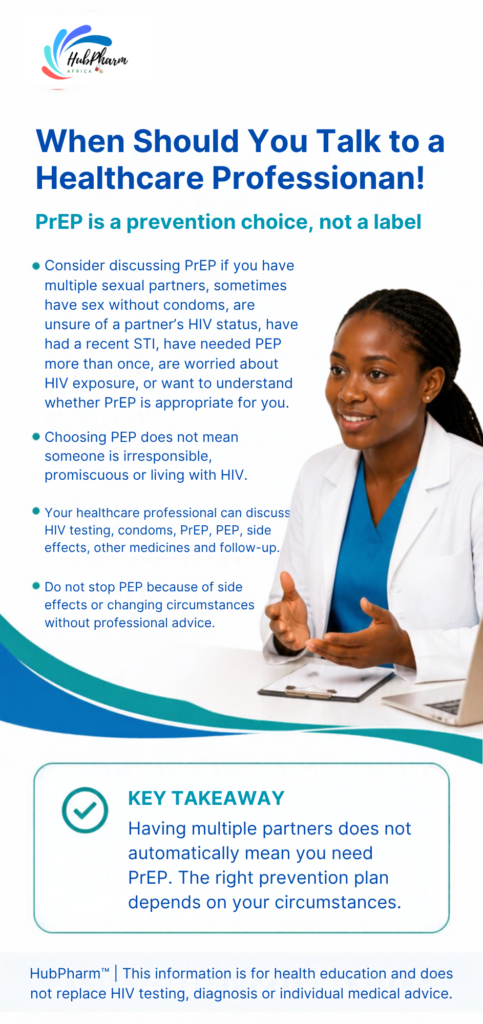
Consider discussing PrEP if:
- You have multiple sexual partners.
- You sometimes have sex without condoms.
- You are unsure of a partner’s HIV status.
- You have had a recent STI.
- You have needed PEP more than once.
- You are worried about your HIV exposure.
- You want to understand whether PrEP is appropriate for you.
You do not need to wait until you think you have HIV before asking about prevention.
Getting Help With HIV Prevention in Nigeria
Choosing between PrEP, PEP, HIV testing and other prevention options can be confusing, especially when your circumstances change.
At HubPharm Africa, our pharmacists can help you understand your medicines and answer questions about your HIV-prevention plan. We provide a respectful and confidential environment for people who need guidance about their medicines or healthcare options.
If you are considering PrEP or are unsure which HIV-prevention option is appropriate, talk to a HubPharm pharmacist →.
You can also link this section internally to the HubPharm PrEP, PEP, HIV testing and pharmacist support pages.
Frequently Asked Questions
Can I take PrEP if I have multiple sexual partners?
Having multiple sexual partners can be one factor that makes PrEP appropriate, particularly when condom use is inconsistent or HIV status is unknown. A healthcare professional should assess your individual circumstances.
Does having multiple partners mean I have HIV?
No. Having multiple partners does not mean that someone has HIV. HIV testing is the only way to know your HIV status.
Can I use PrEP and condoms together?
Yes. They provide different types of protection. PrEP helps prevent HIV, while condoms can reduce the risk of HIV and other STIs and help prevent pregnancy.
Does PrEP protect against STIs?
No. PrEP is specifically designed to prevent HIV. It does not protect against other sexually transmitted infections.
What if I had sex without a condom recently?
If you think you may have been exposed to HIV recently, seek medical advice promptly. Depending on when the exposure occurred, PEP may be appropriate.
Can I stop PrEP if my HIV risk changes?
Possibly, but do not make that decision without appropriate clinical guidance. Your healthcare professional can explain how to safely stop or restart prevention based on your circumstances.
The Bottom Line
Having multiple sexual partners does not automatically mean you need PrEP. However, multiple partners combined with factors such as inconsistent condom use, unknown HIV status or other HIV-risk factors may make PrEP worth discussing with a healthcare professional.
PrEP is one part of HIV prevention. Regular testing, condoms, appropriate treatment and professional follow-up remain important.
If you are unsure whether PrEP is right for you, speak with a qualified healthcare professional or talk to a HubPharm pharmacist for guidance.
Medical note: This article is for health education and does not replace HIV testing, diagnosis or individual medical advice.