What Your Kidneys Actually Do and How to Stop Destroying Them
Most people only learn they have kidney disease after it has already done serious damage. That’s not a dramatic overstatement, it’s how the disease works. Chronic kidney disease (CKD) affects roughly 788 million adults worldwide and kills one person every 20 seconds. By 2040, it is projected to be the fifth leading cause of death globally, overtaking stroke.
In sub-Saharan Africa, the numbers are worse. CKD prevalence across the region sits between 13.9% and 17.7%, above the global average and most of those cases are never diagnosed. In Nigeria specifically, around 200,000 people need dialysis. About 3,000 of them actually get it.
That gap is not just a healthcare system failure. It is largely a prevention failure. The conditions that destroy kidneys (high blood pressure, uncontrolled diabetes, chronic NSAID use, certain herbal concoctions) are all manageable, often reversible, and widely ignored until it is too late.
What the Kidneys Actually Do
Waste removal is the obvious one. The kidneys filter about 180 litres of plasma every day, pulling out urea, creatinine, uric acid, and other metabolic leftovers. Only about 1.5 litres becomes urine, the rest gets reabsorbed.
But filtration is just one job. The kidneys also regulate blood pressure. When blood flow drops, they release renin, which triggers a hormonal cascade that tightens blood vessels and retains sodium, both of which push pressure back up. This is why kidney disease and hypertension are so tightly linked; each makes the other worse.
They also produce erythropoietin (EPO), the hormone that tells bone marrow to make red blood cells. When kidney function falls, EPO production drops, and patients develop anaemia (the persistent fatigue that many people with CKD chalk up to stress or age).
Then there is vitamin D. Most people think vitamin D comes from sunlight and food. It does, but the kidneys are what convert it into the active form (calcitriol) that the body can actually use for calcium absorption and bone strength. Kidney failure without treatment leads to bone disease for exactly this reason.
Beyond that, the kidneys maintain fluid balance (working with the hormone ADH), keep blood pH in the narrow range of 7.35–7.45 where enzymes and proteins function properly, and regulate sodium, potassium, calcium, and phosphorus, any of which, if unchecked, can disrupt heart rhythm, muscle function, or nerve signalling.
That is a lot of work for organs most people cannot locate on a diagram.
Kidney Diseases Worth Understanding
Chronic kidney disease (CKD) progresses through five stages, classified by GFR. The first three are almost always silent. Stage 4 is severely impaired function. Stage 5, GFR below 15 is kidney failure, requiring dialysis or a transplant to survive. Diabetes and hypertension cause the majority of cases worldwide.
Acute kidney injury (AKI) is different: a sudden, often reversible decline triggered by dehydration, sepsis, medication toxicity, or urinary obstruction. Caught early, AKI can resolve completely. Left untreated, it can scar into permanent CKD.
Kidney stones are hard mineral deposits, usually calcium oxalate, that form in the kidney and cause severe pain when they pass. About half of patients have another stone within ten years without dietary changes.
Pyelonephritis is a bacterial infection that has ascended from the bladder to the kidneys. When recurrent or undertreated, it scars renal tissue and contributes to CKD progression.
Polycystic kidney disease (PKD) affects roughly 1 in 800 people. Fluid-filled cysts gradually replace functional tissue, often leading to kidney failure by middle age. It is the most common inherited kidney disorder.
Glomerulonephritis is inflammation of the kidney’s filtering units, triggered by infections, autoimmune diseases such as lupus, or immune-mediated processes. It can cause blood in the urine, protein loss, or rapid kidney decline.
Nephrotic syndrome is defined by heavy protein loss in urine (over 3.5 g/day), low blood albumin, significant swelling, and elevated cholesterol. It signals serious damage to the glomerular filtration barrier.
Signs Something Is Wrong
The disease earns the “silent killer” label because up to 90% of people with CKD have no idea. The early signs are easy to explain away: foamy or bubbly urine from protein leakage; swelling around the eyes, ankles, or feet from fluid retention; persistent tiredness; waking at night to urinate; urine that is pink or darker than usual; or a gradual, unexplained loss of appetite.
Later, when the kidneys are failing, the signs become harder to ignore. Uraemia, the build-up of waste products in blood causes nausea, a persistent metallic taste, and cognitive fog. Fluid overload produces breathlessness and spiking blood pressure. Persistent itching, muscle cramps, and inflammation around the heart follow. At that stage, most of the damage is done.
Why Kidney Disease Is Worse in Nigeria and Africa
Several things compound the problem here specifically.
Diabetes and hypertension are poorly controlled. About 46% of African adults have hypertension, but only around 7% achieve blood pressure control. Nigeria’s diabetes prevalence is now estimated at roughly 7% (around 8 million adults) with 73% of cases undiagnosed. Since these two conditions cause the majority of CKD cases, their poor management fuels a predictable wave of kidney damage downstream.
NSAIDs are everywhere and nobody warns about the kidneys. Self-medication rates in Nigeria sit at roughly 69%, and ibuprofen and diclofenac are among the most consumed. A study in North-Central Nigeria found that 65.9% of NSAID users were unaware of any side effects. This is a problem because NSAIDs block prostaglandins, the compounds that maintain blood flow to kidney nephrons. Used occasionally by a healthy person, the risk is low. Used chronically, or by someone with hypertension, diabetes, or mild CKD, they can trigger acute kidney injury or push a borderline kidney into failure.
Herbal medicine is a major and underappreciated cause of kidney failure. The WHO estimates that up to 80% of Africa’s population relies on herbal medicine for primary healthcare. In Nigeria, herbal concoctions known as agbo are consumed across all social classes. Research estimates herbal remedies account for 30–35% of all acute kidney failure cases in Africa.
One specific danger is aristolochic acid, found in several plant species used in traditional medicine across sub-Saharan Africa. It is a Group 1 carcinogen that causes progressive, irreversible fibrosis of the kidney and bladder cancer. There is no safe dose. Some agbo sellers compound the risk by adulterating their products with unlabelled pharmaceuticals (like tramadol, furosemide, ibuprofen, diazepam) without the buyer’s knowledge.
Other risk factors include obesity, a family history of kidney disease, HIV (which is associated with CKD in an estimated 27% of people living with it in sub-Saharan Africa), and chronic use of mercury-containing skin-lightening creams.
How to Actually Protect Your Kidneys
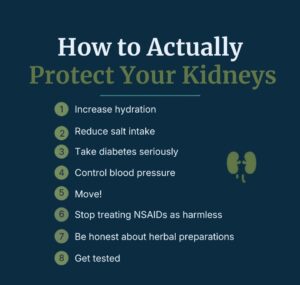
Drink enough water. Aim for 1.5 to 2 litres per day. It supports filtration and reduces stone risk. In advanced CKD, this changes (excess fluid can cause overload) so follow medical guidance at that stage.
Cut salt. The WHO’s recommended limit is 5 grams per day i.e. about one level teaspoon. The global average is 9-12 grams. High sodium raises blood pressure, increases protein leak from the kidneys, and blunts the effectiveness of blood pressure medication.
Take diabetes seriously. About 40% of people with diabetes develop kidney disease. Keeping HbA1c on target matters, and SGLT2 inhibitors, a class of diabetes medications, have proven kidney-protective effects independent of blood sugar control.
Control blood pressure, specifically. The target for anyone with CKD is below 130/80 mmHg. ACE inhibitors and ARBs are preferred because they reduce intraglomerular pressure and cut protein leakage in addition to lowering systemic pressure.
Move!. At least 150 minutes of moderate exercise per week, brisk walking, cycling, swimming, helps with blood pressure, blood sugar, and weight, all of which affect kidney health directly.
Stop treating NSAIDs as harmless. Avoid prolonged use. Never combine them with diuretics and ACE inhibitors/ARBs. This triple combination is a well-documented cause of acute kidney injury.
Be honest about herbal preparations. Some are fine. Many are not tested. Some contain compounds that destroy kidney tissue and are banned in other countries. “Natural” and “safe for your kidneys” are not the same thing.
Get tested. This is the one that most people skip, and the one that matters most.
Foods Worth Eating, Foods Worth Cutting
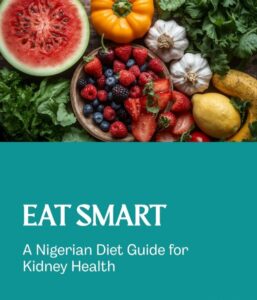
For Nigerian diets specifically, watermelon is worth eating more of (92% water, low potassium and phosphorus), as are cabbage, garlic, onions, mackerel, tilapia, unripe plantain, garden eggs, and ginger, which has shown nephroprotective effects in research. Berries, apples, and cauliflower are good options wherever you can get them.
What causes harm: salt in excess (the average Nigerian consumes roughly double the WHO’s recommended limit without realising it), red and processed meat, sugary drinks, alcohol, and cigarettes. Red meat is particularly relevant, the highest quartile of consumption carries a 73% higher CKD risk than the lowest, mostly through metabolic acid load and gut-derived toxins the kidneys must clear.
Five Things People Believe That Are Wrong
“Only older people get kidney disease.” In Nigeria, the mean age of end-stage kidney disease patients is 42.5 years. Eighty-six percent are under 60.
“Herbal remedies are safe for the kidneys.” Traditional agents have been associated with up to a six-fold increased CKD risk in some African studies.
“You’ll feel it when your kidneys start failing.” Nine out of ten people with CKD are unaware they have it. By the time obvious symptoms appear (nausea, breathlessness, swelling) most of the functional kidney tissue is already gone.
“Drinking more water can reverse kidney disease.” Hydration prevents stones and supports healthy kidneys. It cannot undo fibrosis or structural damage. In advanced CKD, too much fluid is dangerous.
“It is a diabetic disease.” Diabetes is the leading cause. But hypertension, glomerulonephritis, PKD, lupus, medication toxicity, herbal medicine, and HIV all cause substantial CKD burden, including in people with none of the classic risk factors.
Medications Used to Manage Kidney Diseases
There is no single drug for kidney disease because there is no single version of it. Treatment is really a stack of interventions, each one targeting a different thing going wrong at the same time.
Blood pressure and protein leakage are usually the first priority. ACE (angiotensin-converting enzymes) inhibitors like Lisinopril and Enalapril, and ARBs (angiotensin II receptor blockers) like Losartan and Valsartan, both reduce the mechanical strain on the kidney’s filtering units and slow protein loss into the urine. They work through slightly different mechanisms, which is why one is often swapped for the other, not combined. Taking both together raises the risk of acute kidney injury.
SGLT2 (sodium-glucose cotransporter 2) inhibitors, Dapagliflozin and Empagliflozin, have changed the treatment landscape more than any other drug class in the past decade. Originally diabetes medications, they turned out to slow kidney disease in people without diabetes too. They are now part of standard CKD care, not just diabetic kidney care.
Fluid overload is managed with Furosemide, which works fast but has a narrow margin, too much causes the kind of dehydration that makes kidney function worse, not better. Amlodipine is typically added when one blood pressure drug is not enough to hit target.
Anaemia from CKD, the fatigue that does not respond to iron. This is treated with Epoetin Alfa, a synthetic version of the hormone the kidneys stop producing as they fail. Haemoglobin needs watching; the goal is correction, not overcorrection.
Further down the disease, phosphate builds up in the blood. Calcium Carbonate, taken with meals, traps it in the gut before it reaches the bloodstream. Metabolic acidosis i.e. the slow drop in blood pH as kidneys lose the ability to excrete acid, is corrected with Sodium Bicarbonate tablets, one of the simplest and most overlooked interventions in CKD management.
Allopurinol brings uric acid down when levels are high enough to be depositing crystals in kidney tissue or forming stones. For kidney infections, Ciprofloxacin is the go-to for serious cases. Nitrofurantoin is fine for uncomplicated bladder infections, it should be avoided once kidney function is significantly impaired, as it builds up to toxic levels.
All prescription medications listed here: ACE inhibitors, ARBs, SGLT2 inhibitors, Furosemide, Amlodipine, Epoetin Alfa, Allopurinol, and antibiotics require a valid prescription and medical supervision. HubPharm Africa is a PCN-licensed pharmacy with pharmacists available to help you source, verify, and understand your medications.
Have a prescription? Upload it here and we will prepare your order. Questions before you fill? Chat with a pharmacist on WhatsApp same-day delivery available across Lagos.
The Honest Case for Prevention
Eighty percent of patients in Nigeria who begin dialysis cannot sustain it for more than three months. The National Health Insurance Scheme does not cover kidney disease treatment.
For most Nigerians, prevention is not the best option. It is the only one that is realistically available.
The steps are not complicated: manage blood pressure and blood sugar, cut back on salt and red meat, move regularly, drink adequate water, stop buying painkillers like they are sweets, be honest about the agbo question, and get a blood and urine test at your next clinic visit.
Talk to your pharmacist or doctor today. Not when something feels wrong, NOW, while there is still something to protect.
Your health is your wealth. Take the first step today.
Author
Kelvin is a Physiology graduate from the prestigious University of Ilorin, with a background spanning health science, therapy, and health communications. As Content creation Lead at HubPharm Africa, he brings a science-informed perspective to making health information accessible, accurate, and engaging. You can share your perspectives and/or feedback with Kelvin at kelvin@hubpharmafrica.com