Contraception in Nigeria: Methods, Side Effects and What to Know
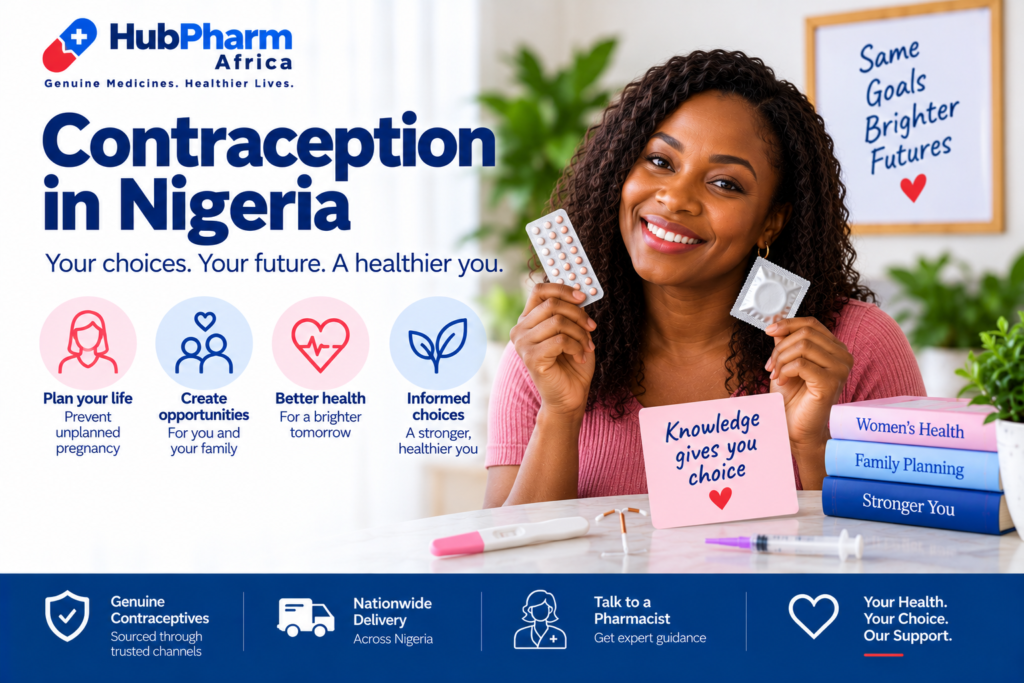
Choosing contraception is not simply about finding a method that prevents pregnancy. It is about finding an option that fits your health, plans, preferences and lifestyle.
In Nigeria, modern contraceptive use among currently married women aged 15 to 49 was 15% in 2024, according to the Nigeria Demographic and Health Survey. Implants and injectable methods were among the most commonly used modern methods. The same survey found that 21% of currently married women had an unmet need for family planning.
At the same time, contraception is often surrounded by questions and misinformation.
Does the pill cause infertility?
Will an implant affect future fertility?
Which method causes the least bleeding?
Can you use contraception if you have certain health conditions?
What happens if you forget a pill?
This guide explains the main contraceptive options available in Nigeria, what they do, their common side effects and when you should speak with a healthcare professional.
What is contraception?
Contraception refers to methods used to prevent pregnancy.
Some methods are temporary and reversible. Others are intended to provide protection for several years, while sterilisation is intended to be permanent.
Modern contraception includes hormonal methods, intrauterine devices, condoms and permanent methods. Each works differently, and no single method is right for everyone. WHO recommends choosing a method based on individual health, preferences and needs.
Importantly, contraception does not cause infertility. Fertility generally returns after stopping reversible contraceptive methods, although the timing can vary depending on the method and the individual.
Why contraception in Nigeria matters
Family planning allows people to decide whether to become pregnant and, where desired, the timing and spacing of pregnancies.
The 2024 NDHS found that 20% of currently married Nigerian women aged 15 to 49 were using some form of family planning, including traditional methods. Modern methods accounted for 15%. Modern contraceptive use was higher in urban areas than rural areas.
Access is not only about whether a method exists.
Cost, availability, misinformation, concerns about side effects and the quality of counselling can all influence contraceptive decisions. The Nigerian government has continued to support family-planning programmes, while the Federal Ministry of Health and Social Welfare maintains a dedicated family-planning programme focused on contraceptive commodities, provider training and supply management.
That makes good information especially important.
The main types of contraception

There are several contraceptive choices. They differ in how long they work, whether hormones are involved and how often they need attention.
| Method | How it works | Hormonal? | Duration |
|---|---|---|---|
| Combined pill | Prevents ovulation and changes cervical mucus | Yes | Taken regularly |
| Progestin-only pill | Mainly prevents ovulation and thickens cervical mucus | Yes | Taken regularly |
| Injection | Provides a contraceptive hormone | Yes | Usually every 2 or 3 months, depending on product |
| Implant | Releases progestin from a small device under the skin | Yes | Several years, depending on product |
| Hormonal IUD | Releases progestin inside the uterus | Yes | Several years, depending on product |
| Copper IUD | Uses copper to prevent fertilisation | No | Several years |
| Condom | Creates a barrier that prevents sperm from reaching an egg | No | Used each time |
| Sterilisation | Permanently prevents pregnancy | No | Permanent |
WHO’s current contraceptive guidance includes pills, implants, injectables, IUDs, condoms, emergency contraception and permanent methods among the available options.
Contraceptive pills
The contraceptive pill is one of the most familiar options.
There are two major types:
Combined oral contraceptive pills
These contain oestrogen and a progestin.
They mainly prevent ovulation and also make it more difficult for sperm to reach an egg. When used correctly, they are highly effective. However, forgetting pills can reduce protection.
Some people also experience lighter or more predictable periods while taking combined pills.
Progestin-only pills
The mini-pill contains progestin without oestrogen.
It can be an option for people who cannot use oestrogen-containing contraception. However, the specific suitability depends on the person’s health and medical history.
Possible side effects include changes in bleeding, headaches, nausea, breast tenderness or mood changes. These effects are not experienced by everyone.
Contraceptive injections
Injectable contraception provides hormones that prevent pregnancy without requiring a daily pill.
Depending on the product, injections are usually given every two or three months.
They can be convenient for someone who does not want to remember a tablet every day. However, changes in bleeding patterns are common, and fertility may take some time to return after stopping certain injectable methods.
The choice of injectable should therefore be discussed with a healthcare professional rather than based solely on convenience.
Contraceptive implants
An implant is a small flexible device placed underneath the skin of the upper arm by a trained healthcare professional.
It releases a progestin and provides long-lasting reversible contraception. Depending on the specific product, protection can last for several years.
One important advantage is that you do not have to remember a daily pill.
Bleeding patterns can change, however. Some users experience irregular bleeding, lighter bleeding or periods that stop altogether.
The implant can be removed when pregnancy is desired.
In Nigeria, implants are among the most commonly used modern contraceptive methods. The 2024 NDHS reported that 88% of implant users obtained their method from the public sector.
IUDs: hormonal and non-hormonal options
An intrauterine device, or IUD, is placed inside the uterus by a trained healthcare professional.
There are two broad types.
Hormonal IUD
A hormonal IUD releases a progestin and provides long-lasting reversible contraception.
For some users, menstrual bleeding becomes lighter over time.
Copper IUD
The copper IUD does not contain hormones.
It uses copper to prevent fertilisation and can provide contraception for many years, depending on the device.
The copper IUD can cause heavier or more painful periods in some users, particularly during the early months.
Because IUD suitability depends on medical history and individual circumstances, assessment by a trained provider is important before insertion.
Condoms are different
Condoms are a barrier method.
They are particularly important because they are the only contraceptive method that also helps protect against sexually transmitted infections, including HIV. Hormonal contraception, implants and IUDs do not provide this STI protection.
For someone who needs both pregnancy prevention and STI protection, condoms may therefore have an important role even when another contraceptive method is being used.
Emergency contraception
Emergency contraception is designed to reduce the chance of pregnancy after contraceptive failure or unprotected sex.
Options include emergency contraceptive pills and the copper IUD. WHO states that emergency contraceptive methods can be used within five days, although effectiveness depends on the method and how soon it is used.
Emergency contraception should not be confused with routine contraception.
It also does not end an established pregnancy.
If emergency contraception is needed repeatedly, a healthcare professional can help identify a regular contraceptive option that may be more convenient.
What about contraceptive side effects?
Side effects vary between methods and between people.
Possible effects include:
- Changes in menstrual bleeding
- Headaches
- Nausea
- Breast tenderness
- Mood changes
- Acne changes
- Abdominal discomfort
- Changes in menstrual flow
A side effect does not automatically mean that a contraceptive is unsafe.
However, severe or unusual symptoms should be assessed rather than ignored.
Hormonal contraceptives containing oestrogen can carry uncommon but important risks, including blood clots, stroke and heart attack in certain circumstances. This is why personal medical history matters when selecting a method.
Can everyone use the same contraceptive?
No.
A method that is appropriate for one person may not be appropriate for another.
Your healthcare professional may consider:
- Age
- Blood pressure
- Smoking status
- Migraine history
- Previous blood clots
- Cardiovascular disease
- Liver disease
- Breast cancer history
- Current medicines
- Whether you are breastfeeding
- Your bleeding pattern
- Your plans for future pregnancy
WHO’s 2025 sixth edition Medical Eligibility Criteria provides recommendations for assessing contraceptive safety across different medical conditions and personal characteristics.
This is why choosing contraception should involve more than simply asking which method is “best.”
Does contraception cause infertility?
This is one of the most common concerns.
Modern reversible contraceptive methods do not cause infertility.
The contraceptive pill does not permanently reduce fertility. Fertility also returns after stopping oral contraceptives, according to WHO.
Likewise, an implant is a reversible method. Once it is removed, its contraceptive effect ends.
If pregnancy does not occur after stopping contraception, there may be another reason unrelated to the contraceptive. Fertility problems can affect either partner and deserve proper medical assessment rather than assumptions about previous contraceptive use.
Which contraceptive method is right for you?
There is no universal answer.
Instead, consider how important each of these factors is to you:
Do you want something you use every day?
A pill may fit your routine.
Would you rather not remember contraception regularly?
An implant or IUD may be worth discussing with a healthcare professional.
Do you want a hormone-free option?
A copper IUD or condoms may be considered.
Do you need STI protection?
Condoms are essential because other contraceptive methods do not protect against STIs.
Do you have a medical condition or take regular medicines?
Ask a healthcare professional to assess which methods are appropriate for you.
Your choice can also change over time. A method that works well during one stage of life may not be the most suitable later.
When should you speak with a healthcare professional?
Seek professional advice if:
- You are unsure which contraceptive to choose
- You have significant medical conditions
- You take several medicines
- You experience troublesome side effects
- Your bleeding pattern changes significantly
- You think your contraceptive may have failed
- You want to switch methods
- You want an implant or IUD
- You are considering permanent contraception
- You have questions about fertility after stopping contraception
You should also seek urgent medical attention for severe symptoms such as sudden chest pain, difficulty breathing, severe abdominal pain, fainting or neurological symptoms.
Getting contraception in Nigeria
Availability can vary between facilities and regions.
The 2024 NDHS found that public-sector facilities were an important source for implants and injectables, while pharmacies were a common source for contraceptive pills and male condoms.
That makes reliable sourcing and proper counselling important.
At HubPharm Africa, contraception should be approached as part of a wider women’s health conversation. A pharmacist can help explain the differences between medicines and products, discuss common side effects and help you understand when a healthcare professional should be involved.
For prescription or clinician-administered methods, the appropriate clinical assessment should come first.
Frequently asked questions
Does contraception stop fertility permanently?
No. Reversible contraceptive methods are designed to prevent pregnancy temporarily. Fertility generally returns after stopping them, although the timing varies by method and individual.
Can contraception protect against STIs?
Condoms can help protect against STIs, including HIV. Hormonal contraception, implants and IUDs do not provide STI protection.
Can teenagers use contraception?
WHO notes that many contraceptive methods can be used safely by adolescents, although individual medical circumstances still need to be considered.
Does the contraceptive pill cause infertility?
No. WHO states that fertility returns quickly after stopping oral contraceptives.
Is contraception only for married women?
No. Contraceptive care is based on an individual’s reproductive health needs, medical eligibility and preferences. Access to family planning is part of comprehensive reproductive healthcare.
Is the implant better than the pill?
They work differently and have different benefits, drawbacks and medical considerations. The appropriate choice depends on the person’s circumstances rather than one method being universally better.
The bottom line
Contraception in Nigeria includes far more than the contraceptive pill.
There are daily pills, injections, implants, hormonal and copper IUDs, condoms, emergency contraception and permanent options. Each has its own benefits, limitations and possible side effects.
The most useful question is therefore not “Which contraceptive is best?”
It is:
“Which option is medically appropriate for me and fits the way I want to manage my reproductive health?”
Good contraceptive care should give you accurate information, explain alternatives and allow you to make an informed choice.
Medical note
This article is for general health education and does not replace an individual consultation with a doctor, pharmacist or other qualified healthcare professional. Contraceptive eligibility can depend on personal medical history, medicines and other factors.
References
- World Health Organization. Family planning/contraception methods, 2025.
- World Health Organization. Medical Eligibility Criteria for Contraceptive Use, 6th edition, 2025.
- World Health Organization. Selected Practice Recommendations for Contraceptive Use, 4th edition, 2025.
- World Health Organization. Oral contraceptives, 2025.
- National Population Commission, Federal Republic of Nigeria. Nigeria Demographic and Health Survey 2024.
- Federal Ministry of Health and Social Welfare, Nigeria. Family Health and Family Planning programme information.