Endometriosis in Nigeria: Why Diagnosis Takes Years
She has had these periods since secondary school. Her mother had them too, so everyone treats the pain as inherited weather rather than illness. By her late twenties she has taken four courses of antibiotics for an infection nobody ever cultured.
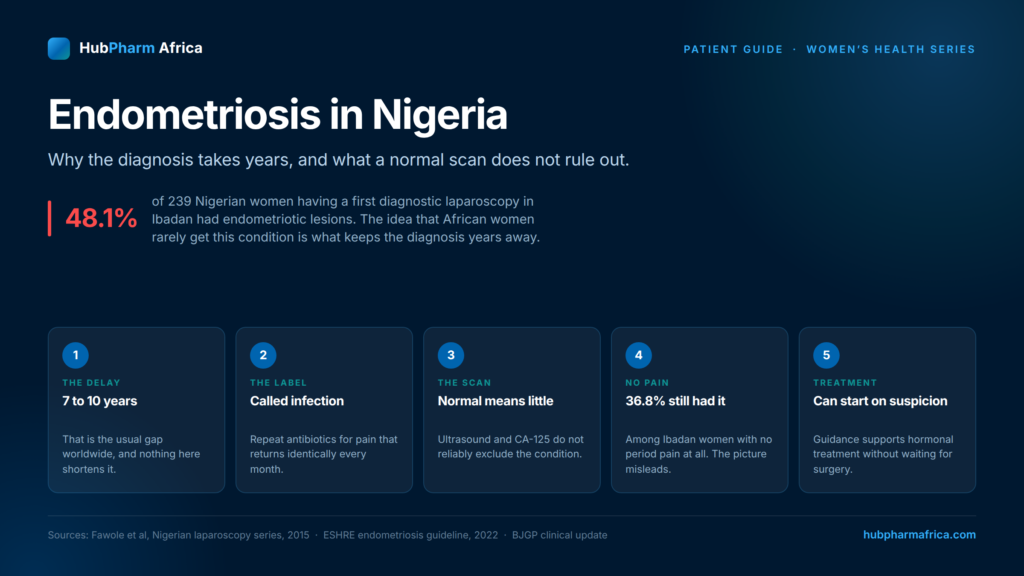
Endometriosis in Nigeria follows that script so often it barely varies. Worldwide the diagnosis takes seven to ten years from the first symptom, and little about Nigerian practice shortens that.
This guide covers what the condition is, why it hides so well here, what the tests can and cannot show, and which treatments actually reduce the pain.
What endometriosis in Nigeria actually is
Tissue similar to the womb lining grows outside the womb, most often on the ovaries, the pelvic lining, the tubes, and occasionally the bowel or bladder.
That tissue responds to the monthly hormone cycle exactly as the lining does. It thickens, it bleeds, and it has nowhere to drain. Consequently the body responds with inflammation, then scarring, then adhesions that stick organs to one another.
So the pain is not imagined, and it is not a low pain threshold. Endometriosis in Nigeria has exactly the same physical cause it has anywhere, and that cause is one a scan frequently cannot see.
Why endometriosis in Nigeria gets missed for years
The belief that African women do not get it
Here is the correction that matters most on this page.
In a study of 239 Nigerian women having a first diagnostic laparoscopy in Ibadan, 48.1 percent had endometriotic lesions. Nearly half.
| Group | Proportion found to have endometriosis |
| Painful periods plus pelvic pain | 71.4% |
| Painful periods alone | 52.6% |
| No painful periods | 36.8% |
Read the last row twice. More than a third of the women with no period pain at all still had lesions, which tells you how poorly the classic symptom picture performs as a filter.
Severe period pain is treated as normal
Girls are told that periods hurt, that marriage will fix it, that childbirth will fix it. Meanwhile the years accumulate.
Pain that keeps you off school or work is not normal. That single sentence, said early enough, would change many of these stories.
It gets labelled infection
Pelvic pain in a Nigerian clinic frequently attracts a diagnosis of pelvic inflammatory disease and a course of antibiotics. Sometimes that diagnosis is right. Where the pain returns identically every month for years, however, it deserves a rethink rather than a repeat prescription.
Laparoscopy is not widely available
Access to laparoscopic surgery remains limited outside a handful of Nigerian centres. Therefore the definitive look inside rarely happens early, and the condition stays a suspicion instead of a diagnosis.
The symptoms that should raise endometriosis in Nigeria

Anything that reliably worsens with menstruation belongs on this list.
- Period pain severe enough to stop work, school or sleep
- Pelvic pain between periods, not only during them
- Pain during or after sex, particularly deep pain
- Cyclical bowel symptoms, including pain opening the bowels around your period
- Cyclical bladder symptoms, including pain passing urine at that time
- Heavy bleeding, or bleeding between periods
- Difficulty conceiving, sometimes with no pain at all
- Exhaustion that arrives with the cycle rather than randomly
Track it for two or three months before your appointment. A written record of which days hurt beats a general complaint, since it makes the cyclical pattern visible to whoever reads it.
How endometriosis in Nigeria is diagnosed
A normal scan does not rule it out
Write this down before your next consultation. Ultrasound and CA-125 are not reliable indicators of whether endometriosis is present. Scans pick up ovarian endometriomas and deep disease reasonably well, although superficial lesions simply do not show.
So being told the scan is normal is not the same as being told nothing is wrong. Ask what the scan can and cannot exclude.
Imaging first, surgery if needed
Current international guidance puts ultrasound or MRI into the work-up, while accepting that a negative result excludes nothing. Laparoscopy follows where imaging is inconclusive or treatment has not worked, and it allows treatment during the same procedure.
Treatment can start before proof
Importantly, guidance supports starting hormonal treatment on clinical suspicion rather than waiting for surgical confirmation. If it helps, that is useful information in itself.
Nevertheless, empirical treatment should never replace the referral. Ask for both.
Treatment for endometriosis in Nigeria
Nothing here cures the condition. Plenty of it controls the pain well, which is a fair goal and an achievable one. Treatment for endometriosis in Nigeria uses the same options used everywhere else, so nobody needs to travel for the basics.
| Option | What it does |
| Combined hormonal contraceptives | Reduce period pain, pelvic pain and pain with sex |
| Progestogens | Recommended to reduce endometriosis-associated pain |
| Hormonal intrauterine system | Strongly recommended, and lasts for years |
| GnRH agonists | Effective, though second line because of side effects |
| NSAIDs | Useful for the pain itself, and best started early in the cycle |
| Surgery | Removes or destroys lesions and divides adhesions |
Suppressing periods is a legitimate plan
Taking a combined pill continuously, so that periods stop, is not a trick or a shortcut. Where there is no bleed, there is far less cyclical pain, and this remains standard practice internationally.
Pain relief works better taken early
Start an NSAID at the first sign rather than when the pain peaks. Take it with food. Furthermore, tell your pharmacist about any stomach trouble, since that changes which one suits you.
Surgery has a real place
Excision or ablation of lesions reduces pain for many women. Adhesions can be divided at the same time. Discuss it with a gynaecologist who does this regularly rather than occasionally.
Endometriosis and fertility
Endometriosis in Nigeria is found in a sizeable share of women investigated for infertility, and the two are genuinely linked through adhesions, distorted anatomy and inflammation.
However, the link is not absolute. Many women with endometriosis conceive without difficulty, so the diagnosis is not a verdict on your chances.
One point deserves emphasis, because local practice often runs the other way. International guidance advises clinicians not to prescribe ovarian suppression in order to improve fertility, and not to prescribe hormone suppression after surgery for that purpose alone. Those treatments manage pain. They do not improve the odds of conceiving, and while you take them you cannot conceive at all.
Therefore if you are trying for a baby and someone has placed you on suppression, ask what the aim is. Ask the question rather than stopping anything yourself.
Living with it while you wait
Diagnosis takes time in every country, and rather longer here. Some things help meanwhile.
Keep the pain diary going. It shortens consultations and it makes dismissal harder.
Treat the fatigue as part of the illness. It is not laziness, and saying so out loud helps at work.
Get a second opinion without guilt. Four antibiotic courses for the same monthly pain is a pattern worth escaping.
Find one doctor who listens. Continuity beats brilliance in a condition managed over years rather than weeks, and endometriosis in Nigeria is very much managed over years.
Common questions
Questions about diagnosis
Can a scan diagnose endometriosis in Nigeria?
Sometimes, for ovarian and deep disease. A normal scan does not exclude it, which is the point most often missed.
Do I definitely need laparoscopy?
Not always. Guidance now supports treating on clinical suspicion, with surgery where imaging is inconclusive or treatment fails.
Is it common in African women?
Yes. Nearly half of the Nigerian women in the Ibadan laparoscopy series had lesions.
Could my pain be something else?
Possibly, since fibroids, PCOS, adenomyosis and infection all cause pelvic pain. That is exactly why a proper assessment matters.
Questions about treatment
Will pregnancy cure it?
No. Symptoms often ease during pregnancy and breastfeeding, and they generally return afterwards.
Does a hysterectomy end it?
Not reliably, because lesions outside the womb can remain. It is a last resort, not a first answer.
Are there non-hormonal options?
NSAIDs, surgery and pain management approaches all help. Discuss what suits you, particularly if hormones are unsuitable.
Can I take the pill continuously?
Many women do, under medical advice, precisely to stop the monthly bleed and the pain attached to it.
Getting help for endometriosis in Nigeria
Managing endometriosis in Nigeria means years of treatment rather than weeks, so reliability matters more than anything dramatic.
At HubPharm Africa we source verified medicines through licensed channels, deliver across Nigeria, coordinate refills so a course does not lapse when it is working, and put a pharmacist on the phone when a side effect makes you want to stop. When Nigerian pharmacies do not routinely stock a product, we tell you honestly whether we can source it and what the lead time looks like, rather than letting you hope. Across our programmes we have seen a 42 percent improvement in medication adherence and 95 percent patient satisfaction.
So start the diary, and take it with you. Pain that stops your life is a reason to be assessed, not a thing to inherit.
[Talk to a HubPharm pharmacist →]
⸻
This article is for general information and does not replace assessment by your own doctor. Hormonal treatments for endometriosis require a prescription, and none should be started or stopped without advice.
References
- Fawole AO et al. Endometriosis and associated symptoms among Nigerian women. International Journal of Gynecology and Obstetrics, 2015.
- ESHRE Endometriosis Guideline Development Group. ESHRE guideline, endometriosis. Human Reproduction Open, 2022.
- Diagnosing endometriosis in primary care, clinical update. British Journal of General Practice, 2015.
- Tuboperitoneal anomalies among infertile women in Nigeria as seen on laparoscopy.
- Aetiological pattern of infertility cases managed at the University of Ilorin Teaching Hospital, North-Central Nigeria.