Infertility in Nigeria: Causes, Tests and Treatment
A Nigerian couple who have not conceived after a year usually start in the wrong place. She goes for tests. She goes alone. Family members offer opinions. Somebody suggests a herbal mixture, somebody else suggests prayer, and eighteen months disappear before anyone books a semen analysis.
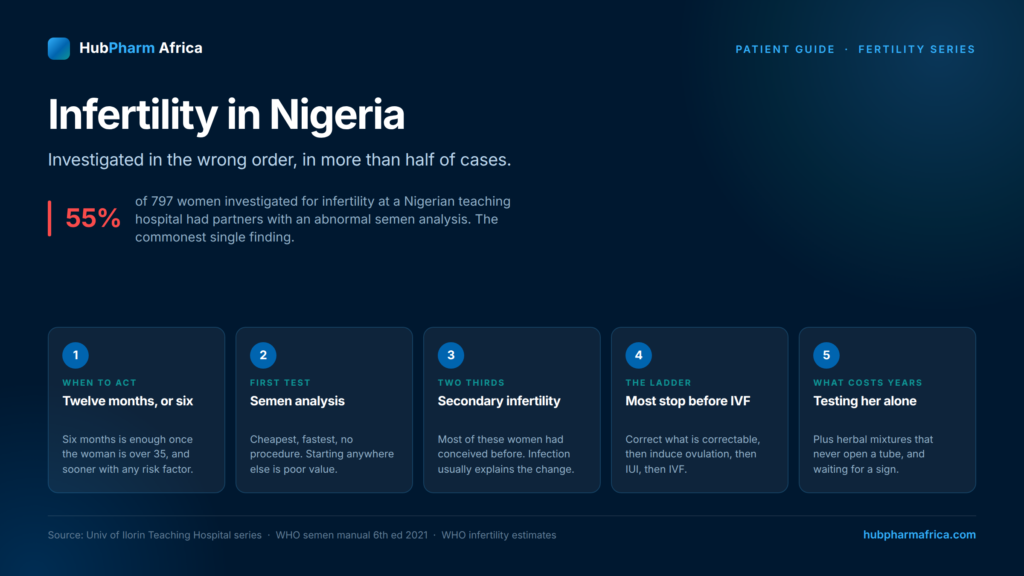
That sequence is the single most expensive habit in this whole field, because the evidence says the opposite. In a study of 797 women investigated for infertility at the University of Ilorin Teaching Hospital, 55 percent had partners with an abnormal semen analysis. It was the commonest single finding.
This guide explains what actually causes infertility in Nigeria, which tests to ask for and in what order, and what treatment realistically involves. Above all, it explains why the order matters so much.
What counts as infertility in Nigeria, and when to act
The working definition is a year of regular unprotected sex without a pregnancy. Globally, roughly one in six people experience infertility at some point in their lives, so nobody reading this is unusual.
Do not wait a full year in these situations.
- The woman is over 35. Six months is enough before seeking help.
- Periods are absent, very irregular or extremely painful.
- There is a history of pelvic infection, ectopic pregnancy or pelvic surgery.
- He has had mumps after puberty, an undescended testis, testicular injury or surgery.
- Either partner already has a known problem.
Above all, go together. Infertility in Nigeria gets investigated as a woman’s problem by default, and that assumption wastes the cheapest test available.
What actually causes infertility in Nigeria
The Ilorin series is worth reading closely, because it describes infertility in Nigeria rather than in Europe, and the pattern differs in ways that change what you should do first.
| Finding | Proportion |
| Partner with abnormal semen analysis | 55% |
| Menstrual disorders | 35% |
| History of dilatation and curettage | 26.7% |
| Pelvic inflammatory disease | 20.8% |
| Obesity | 14.2% |
| Medically unexplained | 10.4% |
Mean age was 32.9 years, and 66.9 percent had secondary infertility, meaning they had conceived at some point before.
Male factor, in more than half of cases
More than half. Not a minority, not an afterthought, and certainly not a reason for shame. Male factor is the leading contributor to infertility in Nigeria, and the country still investigates women first.
Causes include low sperm production, blockage, varicocele, previous infection, hormonal problems, heat exposure, smoking, alcohol and some medicines. Many respond to treatment, and the ones that do not still have routes around them.
Blocked tubes and the infection behind them
Pelvic inflammatory disease appeared in one in five of those women. Untreated chlamydia and gonorrhoea scar the fallopian tubes silently, often with no symptoms at the time.
Consequently, treating a sexually transmitted infection promptly, and treating the partner at the same time, protects fertility years before anyone is trying to conceive.
Ovulation problems
Menstrual disorders showed up in a third of the group. Polycystic ovary syndrome is the commonest cause, and thyroid disease and raised prolactin also stop ovulation. All three respond to treatment.
Secondary infertility, and one uncomfortable finding
Two thirds of these women had conceived before. Something changed in between, and usually that something was infection or instrumentation of the uterus.
A history of dilatation and curettage was the strongest independent predictor of secondary infertility in that study, with an odds ratio of 12.6.
Read that as a reason to treat pelvic infection early, to seek proper care for miscarriage rather than improvised care, and to take post-procedure symptoms seriously. It is not a reason to blame anyone for their history.
The tests, in the order that makes sense
Him first, because it is cheap and quick
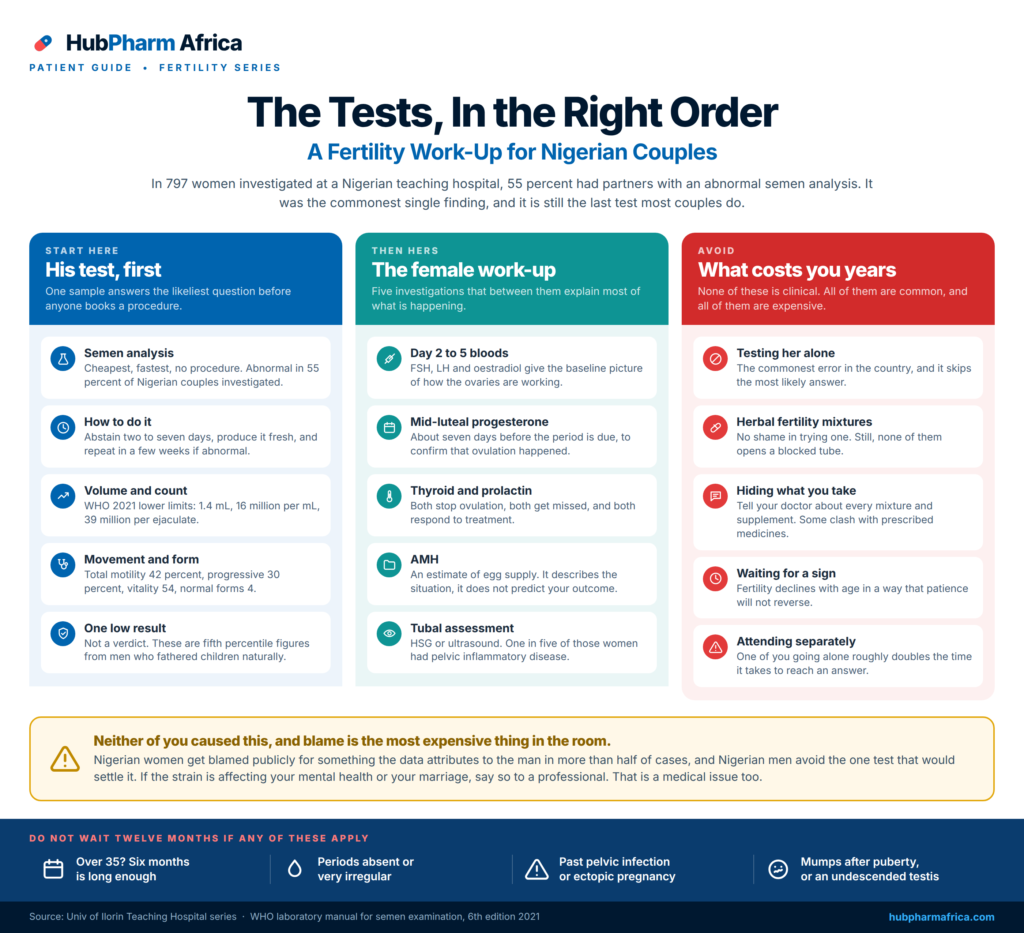
A semen analysis costs a fraction of the female work-up, needs no procedure, and settles or excludes the commonest cause of infertility in Nigeria within a couple of days. Starting anywhere else is poor value.
He should abstain for two to seven days beforehand, produce the sample fresh, and repeat it after a few weeks if abnormal, since results vary.
The WHO 2021 lower reference limits are these.
| Measure | Lower reference limit |
| Volume | 1.4 mL |
| Concentration | 16 million per mL |
| Total sperm number | 39 million per ejaculate |
| Total motility | 42 percent |
| Progressive motility | 30 percent |
| Vitality | 54 percent |
| Normal forms | 4 percent |
One result below a limit is not a verdict. These are fifth percentile figures from men whose partners conceived naturally within a year, so plenty of men below a line still father children.
Her tests
- Day 2 to 5 blood tests, for FSH, LH and oestradiol
- A mid-luteal progesterone, roughly seven days before the period is due, to confirm ovulation
- Thyroid function and prolactin, both of which stop ovulation when abnormal
- AMH, which estimates ovarian reserve
- Pelvic ultrasound, for fibroids, cysts and the appearance of the ovaries
- Tubal assessment, usually by hysterosalpingogram, which checks whether the tubes are open
What a result does not tell you
Tests describe the situation. They do not predict your outcome, and no single number decides whether you will have a child. Plenty of people diagnosed with infertility in Nigeria go on to conceive.
Treatment, from simplest to most involved
Treatment for infertility in Nigeria follows a ladder, and most couples never reach the top of it.
Correct what is correctable. Weight, smoking, alcohol, uncontrolled diabetes or thyroid disease, and untreated infection all matter, and all are cheaper to fix than anything below them.
Ovulation induction. Letrozole or clomiphene where ovulation is the problem. These require ultrasound monitoring, for reasons the clomiphene article explains in detail.
Intrauterine insemination. Washed sperm placed directly into the uterus around ovulation, often with mild stimulation.
IVF and ICSI. Eggs collected after stimulation, fertilised in the laboratory, and an embryo transferred. ICSI injects a single sperm directly into an egg, and it exists largely for severe male factor.
Surgery. For fibroids distorting the cavity, for endometriosis, and occasionally for tubal disease or varicocele.
Your clinic decides which rung fits you. A pharmacy sources, stores, delivers and explains the medicines involved, and it should never be the one choosing your treatment.
Getting help for infertility in Nigeria without losing years
Three things cost couples here more time than anything clinical.
Treating the woman alone. Already covered, and still the commonest error in the country.
Herbal mixtures, cleanses and unregulated “fertility boosters”. No shame attaches to trying one. Still, none of them opens a blocked tube, and some damage the liver or interact with prescribed medicines. Tell your doctor exactly what you are taking rather than hiding it.
Waiting for a sign. Fertility declines with age in a way that patience does not reverse. If it has been a year, or six months past 35, book the tests.
Faith and medicine are not opposites, and plenty of Nigerian couples hold both. The only thing that costs you is delay.
The part nobody writes about
Infertility in Nigeria carries a weight that infertility elsewhere does not. Women get blamed publicly, threatened with replacement, and treated as a failure by people who love them. Men get ridiculed quietly, which is why so many refuse the one test that would help.
Neither of you caused this. The data in this article exists partly to say so in numbers.
If the strain is affecting your mental health, or your marriage, say so to a professional. That is a medical issue too, not a weakness.
Common questions
Questions about causes and tests
How long should we try before seeing someone?
Twelve months of regular unprotected sex, or six months if the woman is over 35, and sooner with any known risk factor.
Should my husband really test first?
Yes. It is cheaper, faster and non-invasive, and it is abnormal in more than half of Nigerian couples investigated.
We already have a child. Can we still be infertile?
Yes, and it is the commoner pattern here. Two thirds of the women in the study cited above had conceived before.
Can stress cause infertility?
Severe stress can disturb ovulation, although it rarely explains a long history on its own. Beware anyone who blames stress and stops investigating.
Questions about treatment
Does everyone with infertility in Nigeria need IVF?
No. Many couples conceive after correcting one thing, and the ladder above exists for that reason.
Do fertility supplements work?
Some nutrients support sperm quality, and evidence is modest rather than dramatic. Treat them as support, never as treatment, and never in place of a semen analysis.
Is a low sperm count permanent?
Often not. Varicocele, infection, hormonal problems and heat exposure can all improve, and ICSI works with very small numbers where they do not.
Where does a pharmacy fit in?
We supply and safeguard the medicines your clinic prescribes, including cold chain products, and we explain them properly. Your clinic runs the cycle.
Treating infertility in Nigeria is also a supply problem
A protocol only works if the medicines are genuine, stored properly and there on the day the calendar says.
That is where HubPharm Africa works. We source verified medicines through licensed channels, hold cold chain products correctly, prioritise same-day dispatch on time-critical fertility items, deliver across Nigeria, and put a pharmacist on the phone when something changes at nine at night. When Nigerian pharmacies do not routinely stock a product, we tell you honestly whether we can source it and what the lead time looks like, rather than letting you hope.
Infertility in Nigeria is not usually a mystery. It is usually investigated in the wrong order. Start with the semen analysis, and go together. Then talk to us about the medicines, whatever the plan turns out to be.
[Talk to a HubPharm pharmacist →]
⸻
This article is for general information and does not replace assessment by a doctor or fertility clinic. Nothing here predicts an individual outcome, and no medicine should be started, changed or stopped without advice from the team looking after you.
References
- Aetiological pattern of infertility cases managed at the University of Ilorin Teaching Hospital in Ilorin, North-Central Nigeria: a 3-year retrospective study.
- World Health Organization, infertility fact sheet and prevalence estimates.
- WHO laboratory manual for the examination and processing of human semen, sixth edition, 2021, lower reference limits.
- High prevalence of male infertility in southeastern Nigeria. Journal of Obstetrics and Gynaecology.
- Causes and risk factors for male-factor infertility in Nigeria: a review. African Journal of Reproductive Health.