PrEP in Nigeria: When Your Partner Has HIV


When one partner has HIV and the other does not, the couple is sometimes described as serodifferent or serodiscordant.
Being in a serodifferent relationship does not mean HIV must be transmitted to the HIV-negative partner. Effective HIV treatment, regular monitoring and appropriate prevention options can greatly reduce the risk of transmission.
One of those options is pre-exposure prophylaxis, or PrEP.
PrEP is HIV medicine taken by people who do not have HIV to reduce their chance of acquiring the virus. When taken as recommended, it is highly effective at preventing HIV.
However, PrEP is only one part of HIV prevention. The HIV-positive partner’s treatment and viral-load status also matter.
What Is PrEP?
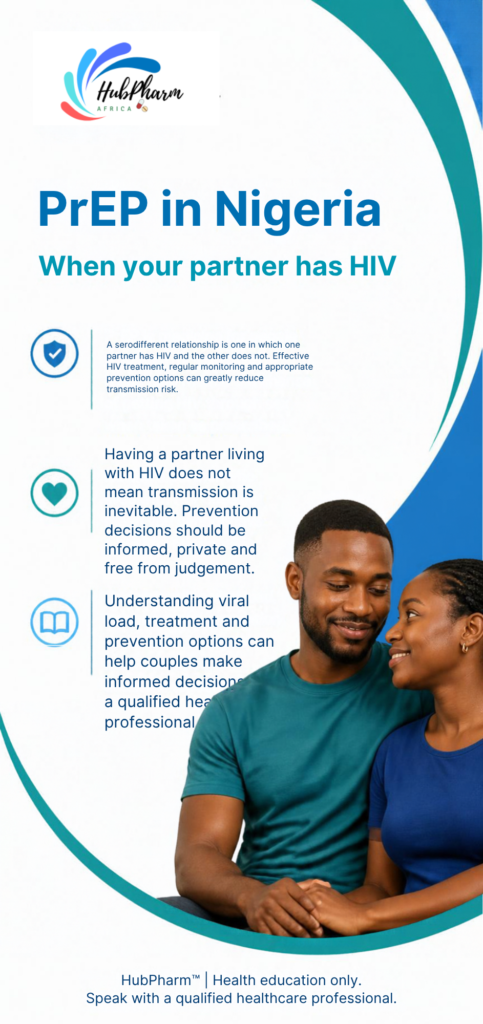
PrEP stands for pre-exposure prophylaxis.
It involves antiretroviral medicine taken by an HIV-negative person before potential exposure to HIV. The medicine helps prevent HIV from establishing an infection after exposure.
WHO recommends PrEP as an additional HIV-prevention option for people who may have a substantial risk of acquiring HIV. Nigeria’s national HIV guidance also identifies serodifferent couples among the groups who may benefit from PrEP.
Importantly, PrEP does not treat HIV in someone who already has the infection.
For this reason, anyone considering PrEP should have appropriate HIV testing and clinical assessment rather than starting treatment independently.
Why PrEP Can Matter When Your Partner Has HIV
If one partner has HIV, several factors can affect the HIV-negative partner’s risk.
These include:
- Whether the HIV-positive partner takes ART consistently
- Whether the treatment works effectively
- The partner’s viral-load result
- Whether other HIV-prevention methods are being used
- Whether either partner has other potential HIV exposures
Therefore, PrEP can provide an additional prevention option for an HIV-negative partner.
Nigeria’s national guidance specifically states that daily oral PrEP may be considered for the HIV-negative partner in a serodifferent relationship when additional prevention choices are needed.
What If Your Partner Is Undetectable?

This is one of the most important facts for couples to understand.
When a person living with HIV takes ART consistently and maintains an undetectable viral load, they do not transmit HIV through sex.
WHO describes this principle as Undetectable = Untransmittable (U=U).
In other words, effective HIV treatment protects the health of the person living with HIV while also preventing sexual transmission.
However, viral suppression needs confirmation through appropriate viral-load testing and ongoing clinical care. Feeling healthy or taking HIV medicine does not, by itself, confirm that someone has an undetectable viral load.
Does the HIV-Negative Partner Still Need PrEP?
There is no single answer for every couple.
Nigeria’s national guidance states that an HIV-negative partner may discontinue PrEP when the HIV-positive partner has achieved viral suppression and continues to adhere to ART.
Even so, the decision to start or stop PrEP should involve an appropriately trained healthcare professional.
Other circumstances may also affect the prevention plan. For example, the HIV-negative partner may have other potential HIV exposures.
Therefore, couples should discuss their individual circumstances rather than making medication decisions based only on general information.
PrEP Does Not Replace HIV Testing
Before starting PrEP, a person needs to know their HIV status.
This matters because PrEP is intended for people who do not have HIV. Someone who may already have HIV needs appropriate HIV evaluation and treatment instead of using PrEP as a substitute for HIV care.
Regular HIV testing may also form part of ongoing PrEP care.
For couples, testing can provide reassurance while helping healthcare professionals choose an appropriate prevention strategy.
PrEP and Condoms
PrEP and condoms serve different purposes.
PrEP specifically helps prevent HIV acquisition. Condoms can reduce the transmission of HIV and other sexually transmitted infections while also helping prevent pregnancy.
Therefore, taking PrEP does not automatically mean that condoms are no longer useful.
A healthcare professional can help an individual or couple decide which prevention options best fit their circumstances.
Is PrEP 100% Effective?
No prevention method should be described as providing absolute protection in every situation.
PrEP is highly effective when taken as recommended. However, protection depends on using the appropriate PrEP option correctly and following the required clinical monitoring.
WHO describes PrEP as capable of practically eliminating the chance of acquiring HIV when taken as recommended.
For that reason, adherence, HIV testing and follow-up remain important.
What About PrEP Side Effects?
Like other medicines, PrEP can cause side effects in some people.
The appropriate PrEP option also depends on a person’s health history, other medicines and clinical circumstances.
If you experience side effects or have concerns about interactions, speak with a qualified healthcare professional rather than stopping the medicine on your own.
This is particularly important because HIV prevention needs to reflect each person’s circumstances.
PrEP Access in Nigeria
Nigeria continues to expand HIV-prevention services.
In September 2026, WHO reported that Nigeria had strengthened its PrEP workforce through national training involving healthcare workers from 32 states and the Federal Capital Territory. The programme supports efforts to integrate PrEP into HIV-prevention services and expand access to prevention choices.
Nigeria’s 2026 national consolidated HIV guidelines also identify PrEP as an important prevention intervention and include services for people in serodifferent relationships.
As a result, conversations about PrEP are becoming a more routine part of HIV-prevention care.
PrEP Is Not the Same as PEP
The names sound similar, but PrEP and PEP are different.
PrEP is taken by an HIV-negative person as a prevention strategy before potential exposure.
PEP, or post-exposure prophylaxis, is an emergency HIV-prevention option used after a potential exposure.
If you think you have recently been exposed to HIV, seek urgent medical advice rather than assuming that PrEP is the appropriate option.
When Should You Speak With a Healthcare Professional?
Consider speaking with a qualified healthcare professional if:
- One partner has HIV and the other does not.
- You do not know the HIV-positive partner’s current viral-load status.
- The HIV-negative partner is considering PrEP.
- You are concerned about a possible HIV exposure.
- Either partner has questions about HIV testing.
- You have questions about an HIV medicine or prevention medicine.
A healthcare professional can assess the situation and explain the available prevention choices without judgement.
Getting Help With HIV Prevention in Nigeria
Understanding whether you need PrEP, PEP, an HIV test or another prevention option can sometimes be confusing.
At HubPharm Africa, our pharmacists can help you understand your prescribed medicines and answer questions about your treatment or prevention plan. We also believe that sensitive health questions deserve privacy, respect and a judgement-free approach.
If you are unsure about a medicine or have questions about your HIV-prevention plan, talk to a HubPharm pharmacist →. HubPharm Africa
You can also link this section internally to your HIV/PrEP page, PEP page and pharmacist support/contact page.
Frequently Asked Questions
Can someone with an HIV-positive partner use PrEP?
Yes. Nigeria’s national guidance identifies serodifferent couples among groups who may benefit from PrEP. A healthcare professional should determine whether it is appropriate for the HIV-negative partner.
If my partner is undetectable, can HIV still be transmitted?
When a person living with HIV maintains an undetectable viral load while taking effective ART, they do not transmit HIV sexually.
Does PrEP treat HIV?
No. PrEP helps prevent HIV acquisition in people who do not have HIV.
Does PrEP protect against other STIs?
No. PrEP specifically targets HIV prevention. Other prevention measures, including condoms, can help reduce the risk of other sexually transmitted infections.
Should I start or stop PrEP on my own?
No. HIV testing and professional assessment are important when starting or changing PrEP. Discuss any decision to start or stop with a qualified healthcare professional.
Can I ask a pharmacist about my PrEP or HIV medicine?
Yes. A pharmacist can explain prescribed medicines, discuss potential concerns and help you understand when you should speak with your doctor or another healthcare professional.
The Bottom Line
Having an HIV-positive partner does not mean HIV transmission is inevitable.
ART, viral-load suppression, U=U, PrEP, condoms and regular testing can all play important roles in HIV prevention. The right combination depends on the circumstances of each person and couple.
If you are considering PrEP, start with an HIV test and discuss your prevention options with a qualified healthcare professional.
Medical note: This article is for health education and does not replace individual medical advice, HIV testing or clinical assessment.