Schizophrenia in Nigeria: Symptoms, Treatment and Support

Schizophrenia is a serious mental health condition that can affect how a person perceives reality, thinks, behaves and relates to other people. It can affect education, work, relationships and everyday activities.
The condition can involve psychosis, including hallucinations, delusions and disorganised thinking. However, schizophrenia is more than simply “hearing voices,” and symptoms can vary considerably between people.
Importantly, effective treatment and support are available. WHO reports that at least one in three people with schizophrenia can achieve complete recovery from symptoms.
Early professional assessment matters because untreated psychosis can interfere significantly with a person’s health and everyday functioning.
What Is Psychosis?

Psychosis describes a group of symptoms in which a person’s perception or interpretation of reality becomes significantly altered.
Hallucinations
A person may hear, see, smell, feel or experience something that other people do not.
Hearing voices is one possible example, but hallucinations are not limited to hearing.
Delusions
These are strongly held beliefs that remain fixed despite evidence that contradicts them.
The person experiencing the belief may find it completely convincing. Arguing aggressively about the belief is therefore unlikely to resolve the problem.
Disorganised thinking
A person’s thoughts or speech may become difficult to follow. They may jump between ideas or find it difficult to communicate clearly.
Changes in behaviour
Psychosis can also involve unusual behaviour, severe agitation or significant changes in everyday functioning.
Not everyone who experiences psychosis has schizophrenia. Psychosis can occur with other mental health conditions, medical conditions or certain substances. A professional assessment is therefore essential.
Symptoms of Schizophrenia
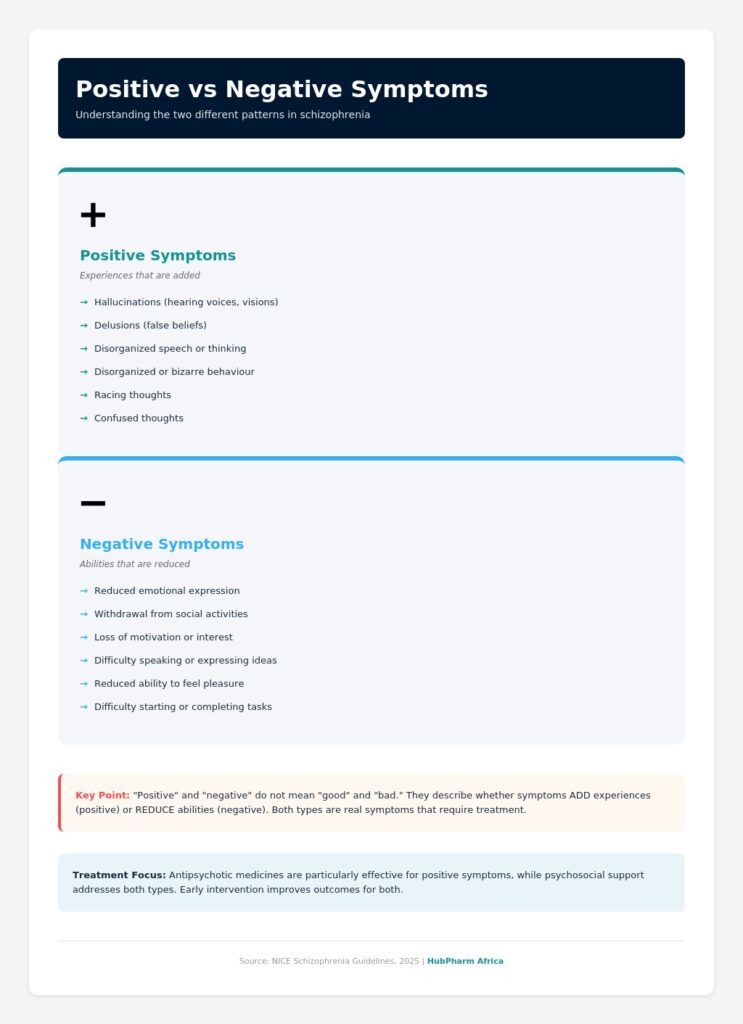
Symptoms are often grouped into several categories.
Positive symptoms
These include experiences added to a person’s usual experience, such as:
- Hallucinations
- Delusions
- Disorganised speech
- Significant behavioural changes
Negative symptoms
These involve reduced or lost abilities, such as:
- Reduced motivation
- Less interest in activities
- Social withdrawal
- Reduced emotional expression
- Difficulty initiating everyday activities
Cognitive difficulties
Some people experience problems with:
- Attention
- Memory
- Planning
- Processing information
- Concentration
These difficulties can continue even when the most obvious psychotic symptoms improve.
Schizophrenia in Nigeria: Why Early Care Matters
Nigeria-specific research shows that people with schizophrenia may follow complicated routes before reaching specialist mental-health care.
A Lagos study of 138 people with schizophrenia found that 69% first contacted traditional or religious healers. Those who first contacted non-orthodox providers made more contacts before reaching mental-health services and had a longer duration of untreated psychosis.
Similarly, a study involving 367 people presenting to a psychiatric hospital in southeastern Nigeria found that about 76% had visited traditional or faith healers as their first treatment option. Long distance and first using traditional healers were associated with treatment delay.
These findings do not mean that every person in Nigeria follows the same pathway. They do, however, show why mental-health education and timely access to appropriate professional care matter.
How Is Schizophrenia Diagnosed?

There is no single blood test that confirms schizophrenia.
Instead, a mental-health professional considers the person’s symptoms, history, functioning and other possible explanations.
The assessment may explore:
- When symptoms began
- Changes in behaviour
- Hallucinations or unusual beliefs
- Thinking and communication
- Mood symptoms
- Sleep
- Physical health
- Previous treatment
- Family history
- Current medicines
- Alcohol or other substance exposure
The clinician may also need to consider medical conditions that can produce similar symptoms.
Because psychosis has several possible causes, an appropriate assessment is more useful than trying to diagnose schizophrenia from one symptom alone.
Treatment for Schizophrenia

Treatment usually combines several forms of support.
Antipsychotic treatment
Antipsychotic medicines are a major part of treatment for schizophrenia and other psychotic disorders. They can help reduce symptoms such as hallucinations, delusions, agitation and disorganised thinking.
The choice of medicine depends on the individual’s symptoms, previous treatment, side effects, other health conditions and preferences.
Treatment should therefore be managed by an appropriately trained healthcare professional.
Psychological and social support
Medicine is not the only part of schizophrenia care.
WHO recommends combining pharmacological treatment with psychosocial interventions. These can include family psychoeducation, cognitive-behavioural therapy, social-skills training, illness-management education and supported employment.
These interventions can help a person manage everyday activities, relationships, work and independent living.
Family involvement
Families often play an important role in supporting someone with schizophrenia.
Family education can help relatives understand symptoms, recognise changes and communicate more effectively with the healthcare team.
WHO identifies family interventions and psychoeducation as important components of care.
Why Continuing Treatment Matters
Schizophrenia can follow a relapsing course, so treatment often involves ongoing follow-up rather than a short course of care.
WHO’s current guidance recommends maintenance antipsychotic treatment after a first psychotic episode has remitted, balancing effectiveness, side effects and individual preferences.
This does not mean everyone receives exactly the same treatment for the same length of time.
Instead, the healthcare professional should regularly review the person’s progress and adjust the treatment plan when necessary.
A person should not stop or change prescribed treatment without discussing it with the clinician responsible for their care.
Monitoring Physical Health
Mental-health treatment should also include attention to physical health.
Some antipsychotic medicines can affect metabolic health, so healthcare professionals may monitor factors such as weight, blood pressure and blood glucose or HbA1c. NICE also recommends appropriate physical-health monitoring for people taking antipsychotic medication.
This is important because people living with schizophrenia have a higher risk of physical health problems and, on average, a shorter life expectancy than the general population. WHO estimates that people with schizophrenia die around nine years earlier on average, often because of physical illnesses such as cardiovascular and metabolic disease.
Schizophrenia Is Not the Same as “Split Personality”
This is an important misconception.
Schizophrenia does not mean that someone has multiple personalities.
The name of the condition is sometimes misunderstood because of its historical terminology. In reality, schizophrenia primarily involves disturbances in perception, thinking, behaviour and functioning.
Using accurate language can also reduce the stigma experienced by people living with the condition.
Supporting Someone With Schizophrenia
Family members and friends can provide valuable support.
Helpful approaches include:
- Listening without mocking or dismissing the person’s experience
- Encouraging professional care
- Helping with appointments when appropriate
- Supporting regular routines
- Learning about the condition
- Watching for significant changes in behaviour
- Communicating concerns to the healthcare team
When someone is experiencing a strong unusual belief or hallucination, directly confronting or humiliating them may increase distress.
Instead, calm communication and professional support are generally more appropriate.
When Should You Seek Urgent Help?

New or severe psychotic symptoms deserve prompt professional assessment.
Urgent help is particularly important when someone is:
- Extremely confused or agitated
- Unable to care for basic needs
- Behaving in a way that creates immediate danger
- Experiencing severe psychotic symptoms
- At immediate risk of harming themselves or someone else
In an emergency, involve a trusted adult, family member or appropriate emergency healthcare service immediately.
Getting Help With Prescribed Mental-Health Medicines
Managing schizophrenia can involve long-term treatment and regular follow-up. Patients and families may also have questions about prescribed medicines, monitoring and treatment routines.
HubPharm Africa can provide pharmacist support for questions about prescribed medicines and help patients understand their treatment plan.
Have questions about a prescribed mental-health medicine? [Talk to a HubPharm Pharmacist →]
For your website, I recommend linking this CTA to your Mental Health Medicines page, while “Talk to a HubPharm Pharmacist” should link to your contact/pharmacist-support page.
We should only mention specific medicines or availability when HubPharm has verified that information.
Frequently Asked Questions
Is schizophrenia treatable?
Yes. Effective treatments and psychosocial interventions are available. WHO reports that at least one in three people with schizophrenia can achieve complete recovery from symptoms.
Does schizophrenia mean someone has multiple personalities?
No. Schizophrenia and dissociative identity disorder are different conditions.
Can someone with schizophrenia live independently?
Some people can live independently, while others need varying levels of support. Psychosocial rehabilitation, supported employment and supported housing can form part of recovery-oriented care.
Can schizophrenia happen in young people?
Yes. Onset most often occurs during late adolescence and the twenties, although the exact pattern varies between individuals.
Can schizophrenia go away completely?
Some people achieve complete remission of symptoms, while others experience periods of improvement and relapse. Ongoing care can help manage symptoms and support recovery.
Should someone stop their antipsychotic medicine when they feel better?
Treatment changes should be discussed with the healthcare professional managing the condition. Stopping treatment without appropriate medical supervision can increase the risk of symptoms returning.
The Bottom Line
Schizophrenia is a treatable mental health condition that can affect perception, thinking, behaviour and everyday functioning.
In Nigeria, research has documented delays in reaching specialist mental-health care and complicated pathways to treatment.
Early assessment, appropriate treatment, family education and ongoing support can all form part of effective care.
Most importantly, schizophrenia should be approached as a health condition rather than a character flaw. People living with it deserve appropriate treatment, dignity and support.
Medical note: This article is for health education and does not replace assessment or treatment from a qualified healthcare professional.
References
- World Health Organization. Schizophrenia, 2026.
- NICE. Psychosis and schizophrenia in adults: prevention and management (CG178).
- WHO mhGAP. Psychosis and schizophrenia pharmacological treatment guidance.
- The Pathways to the First Contact with Mental Health Services among Patients with Schizophrenia in Lagos, Nigeria.
- The socio-demographic characteristics and patterns of help-seeking among patients with schizophrenia in south-east Nigeria.
- WHO. Pharmacological treatment of schizophrenia.