Rheumatoid Arthritis in Nigeria: Treatment That Works

If your hands hurt every morning and take an hour to loosen, it is easy to blame age, hard work or sleeping badly.
If your knees swell, you may be told it is wear and tear.
If the pain moves from one joint to another, you may be treated for malaria, gout or another common cause of joint pain.
Sometimes those explanations are correct.
Sometimes they are not.
Rheumatoid arthritis is an autoimmune disease that can permanently damage joints if inflammation is left untreated. The important point is that treatment does not have to wait until your fingers become visibly deformed. Modern treatment aims to control inflammation early, prevent joint damage and help people remain active.
For rheumatoid arthritis in Nigeria, however, the challenge is often getting the correct diagnosis and reaching a rheumatologist early enough.
What rheumatoid arthritis actually is
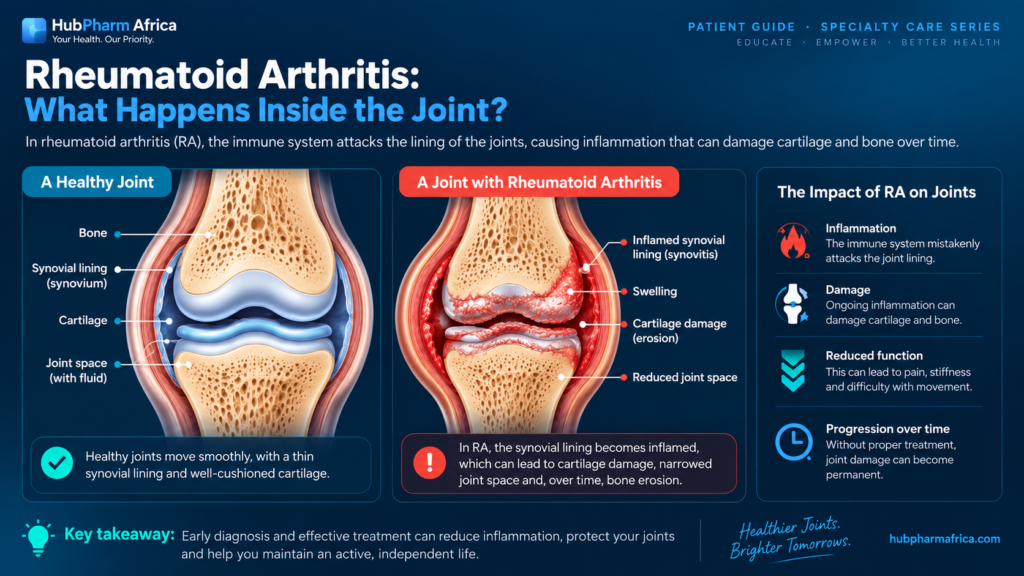
Rheumatoid arthritis, or RA, happens when the immune system mistakenly attacks the lining of the joints.
The resulting inflammation causes pain, swelling and stiffness. Over time, persistent inflammation can damage cartilage, bone and surrounding tissues.
RA most commonly affects the hands, wrists and feet, but it can affect other joints and can also involve parts of the body outside the joints.
It is different from ordinary osteoarthritis.
Osteoarthritis is primarily associated with wear, structural changes and degeneration of joints. Rheumatoid arthritis is an immune-mediated inflammatory disease.
That distinction matters because taking painkillers alone does not stop rheumatoid arthritis from damaging the joints.
What rheumatoid arthritis feels like

Morning stiffness that lasts
One of the classic symptoms is stiffness after waking.
A person with RA may find that the hands or other affected joints feel difficult to move in the morning and gradually loosen as they become active.
Persistent morning stiffness is more concerning when it occurs alongside swelling and pain in several joints.
Swollen joints
RA commonly causes visible or noticeable swelling.
The hands and wrists are frequent sites, and the disease can affect joints on both sides of the body.
For example, both wrists or several joints in both hands may become painful and swollen.
Pain that keeps returning
RA is not simply an occasional ache after physical activity.
Symptoms can persist or repeatedly return, and periods of worsening may alternate with periods when symptoms are quieter.
Fatigue and feeling unwell
Some people with RA experience significant tiredness, weakness or a general feeling of being unwell.
This can make the disease particularly easy to confuse with other conditions.
Why rheumatoid arthritis in Nigeria is often diagnosed late
The problem is not that Nigerians do not develop rheumatoid arthritis.
The problem is that the condition can be difficult to recognise early, while access to specialist rheumatology care remains limited.
A Nigerian study of patients with RA found a mean symptom duration of more than five years before presentation to a rheumatology clinic.
Another study of RA patients found that delays in seeing a rheumatologist, misdiagnosis and delayed treatment were associated with worse disease activity and poorer functional outcomes.
Joint pain has many possible explanations
In Nigeria, a person with fever, body pain or joint pain may initially be assessed for infections or other common illnesses.
That is understandable because those conditions are common.
The problem begins when the symptoms continue, keep returning or develop a recognisable inflammatory pattern but the possibility of RA is never considered.
Many patients see several healthcare providers
Delayed referral can add months or years to the diagnostic journey.
Patients may first see a general practitioner, orthopaedic specialist or another healthcare provider before reaching a rheumatologist.
Some people also seek traditional or alternative treatment.
The important point is not to blame the patient. The longer the disease remains uncontrolled, the greater the opportunity for inflammation to cause permanent damage.
How rheumatoid arthritis is diagnosed

There is no single test that proves every case of rheumatoid arthritis.
A rheumatologist usually combines several pieces of information.
Your symptoms and joint examination
The pattern of pain, swelling and stiffness matters.
A doctor will examine which joints are affected, whether they are swollen and whether the pattern suggests inflammatory arthritis.
Blood tests
Depending on the situation, testing may include:
- Rheumatoid factor
- Anti-CCP antibodies
- Full blood count
- ESR or CRP to assess inflammation
- Kidney and liver tests before and during treatment
A negative rheumatoid factor does not automatically mean you do not have RA.
Similarly, a positive rheumatoid factor does not by itself prove that a person has rheumatoid arthritis.
The results have to be interpreted alongside the clinical picture.
Imaging
X-rays may be used to assess structural damage.
Ultrasound or MRI can sometimes detect inflammation or damage that is not obvious on a physical examination.
The exact investigations depend on the patient and what the doctor suspects.
The most important treatment principle: start early
The goal of RA treatment is not simply to make the pain disappear for a few hours.
The goal is to control the underlying inflammation.
Current EULAR recommendations state that disease-modifying antirheumatic drug treatment should begin as soon as RA is diagnosed, with treatment aimed at sustained remission or low disease activity.
This approach is often described as treat to target.
The target is agreed with the healthcare team, disease activity is monitored and treatment is adjusted when the target is not being reached.
That is very different from taking medication only when the pain becomes unbearable.
Methotrexate is often the starting point
Methotrexate is one of the most important medicines used to control rheumatoid arthritis.
It is a disease-modifying antirheumatic drug, commonly called a DMARD.
Instead of simply masking pain, it suppresses the abnormal immune activity driving inflammation.
The 2025 EULAR recommendations continue to place methotrexate at the centre of the initial treatment strategy.
That is also reflected in Nigerian practice.
A survey of Nigerian rheumatologists found methotrexate was the preferred initial DMARD monotherapy for 88.5% of respondents. The study also found that conventional synthetic DMARDs remain the commonly available and widely used treatment options in Nigeria, while biologic prescribing remains low.
Methotrexate is taken weekly, not daily
This is one of the most important medication-safety points.
Methotrexate used for rheumatoid arthritis is generally taken once a week, according to the schedule prescribed by the treating clinician.
Taking it every day instead of weekly can cause severe and potentially life-threatening toxicity.
Write the prescribed day clearly on the medication packaging.
If you receive your medicine from a different pharmacy or the brand changes, check the instructions again rather than assuming the new package is identical.
Folic acid is also commonly prescribed alongside methotrexate to reduce certain side effects.
Never change the methotrexate dose yourself.
What if methotrexate does not work?
Methotrexate is not the only treatment.
Depending on the individual patient, the rheumatologist may use another conventional DMARD such as:
- Leflunomide
- Sulfasalazine
- Hydroxychloroquine in appropriate situations
The choice depends on disease severity, other health conditions, pregnancy considerations, previous treatment, test results and medication tolerance.
If the treatment target is not achieved, current guidance supports moving to additional targeted treatment rather than allowing uncontrolled inflammation to continue indefinitely.
Where biologics fit in

Biologic medicines have changed the treatment of severe inflammatory diseases.
For RA, options include medicines that target tumour necrosis factor and other inflammatory pathways.
Examples include:
- Adalimumab
- Etanercept
- Infliximab
- Rituximab
- Tocilizumab
The choice depends on the individual clinical situation.
However, access to biologics in Nigeria can be more difficult than simply receiving a prescription.
Supply, continuity, storage requirements and specialist monitoring all matter.
That is why a treatment plan should consider not only whether a medicine works, but whether the patient can realistically receive it consistently.
The tuberculosis check that should not be skipped
This is especially important when treatment involves certain biologic medicines, particularly TNF inhibitors.
These medicines can increase the risk of reactivating latent tuberculosis.
Guidance recommends screening for latent TB before biologic treatment, using appropriate testing and clinical assessment.
For a patient in Nigeria, this deserves particular attention because tuberculosis remains an important public-health concern.
Before starting a TNF inhibitor, the healthcare team may consider:
- Previous tuberculosis history
- TB exposure
- Tuberculin skin testing or an interferon-gamma release assay where available
- Chest imaging
- Other individual risk factors
If latent TB is identified, the healthcare team can decide how it should be treated and when immunosuppressive therapy should begin.
If you are being offered a biologic for rheumatoid arthritis and nobody has discussed tuberculosis screening, ask about it before treatment starts.
Steroids can help, but they are not the whole treatment
Prednisolone and other corticosteroids can reduce inflammation quickly.
They may be used for short periods while disease-modifying treatment begins to work.
But long-term steroid exposure carries important risks.
Current EULAR guidance recommends that when steroids are used during initiation or adjustment of conventional DMARD treatment, they should be tapered and discontinued as rapidly as clinically feasible.
Do not suddenly stop long-term steroids on your own.
If you have been taking them for an extended period, your doctor may need to reduce the dose gradually.
What happens if rheumatoid arthritis is ignored?
Untreated or inadequately controlled RA can cause more than pain.
Persistent inflammation can lead to:
- Permanent joint damage
- Reduced hand function
- Difficulty walking
- Loss of independence
- Work limitations
- Chronic fatigue
- Reduced quality of life
The Nigerian evidence on diagnostic and treatment delay is particularly important here.
Patients with longer delays have been found to have higher disease activity and worse functional outcomes.
That is why waiting until the joints are visibly deformed is the wrong strategy.
Can someone with rheumatoid arthritis live a normal life?
Yes.
RA is usually a chronic condition rather than something that can simply be cured with a short course of medicine.
But effective treatment can put the disease into remission or low disease activity.
The aim is to control inflammation early, protect the joints and maintain normal daily function as much as possible.
Someone whose RA is well controlled may be able to work, exercise, travel and carry out everyday activities normally.
The important part is continuing the treatment plan and monitoring the disease.
What you should take to your rheumatology appointment
If you are seeing a specialist for possible or confirmed RA, bring:
- Previous blood-test results
- X-rays or scan reports
- A list of current medicines
- Previous prescriptions
- A record of when your symptoms started
- A list of joints that become swollen or painful
- Information about morning stiffness
- Any previous diagnosis you were given
- Information about herbal or traditional preparations you use
A simple symptom timeline can be surprisingly useful.
Write down when the symptoms started, which joints were affected first and how the pattern changed.
When rheumatoid arthritis needs urgent attention
RA itself is usually managed as a chronic condition, but certain symptoms require prompt medical assessment.
Seek urgent care for:
- Severe chest pain or difficulty breathing
- Sudden weakness, confusion or neurological symptoms
- A high or persistent fever while taking immunosuppressive medication
- A severely swollen, hot joint accompanied by fever
- Severe weakness or other symptoms after taking methotrexate incorrectly
- Signs of a serious medication reaction
Do not assume every new symptom is simply an RA flare.
People receiving immunosuppressive treatment can have infections and other complications that require different treatment.
Common questions
How do I find a rheumatologist in Nigeria?
Ask your doctor or hospital for referral to a rheumatology service, particularly at a teaching or specialist hospital.
Because rheumatology services are concentrated in major urban centres, some patients may need to travel for specialist assessment.
Take previous test results and medication records with you.
What are the first symptoms of rheumatoid arthritis?
Common symptoms include persistent joint pain, swelling and prolonged morning stiffness, particularly when several joints are affected.
Fatigue and general unwellness can also occur.
Symptoms alone cannot confirm RA, so persistent inflammatory joint symptoms should be medically assessed.
Is rheumatoid arthritis curable?
There is currently no simple cure that permanently removes RA.
However, remission or very low disease activity is a realistic treatment goal for many patients.
The aim is to control inflammation and prevent permanent joint damage.
Is methotrexate safe?
Methotrexate can be an effective and appropriate treatment for RA when prescribed and monitored correctly.
It can also cause serious side effects, so patients usually require monitoring and should follow the prescribed weekly schedule carefully.
Never take extra doses because you think the medicine is not working quickly enough.
Can I stop my rheumatoid arthritis medicine when I feel better?
Do not stop it without speaking to your healthcare team.
Feeling better may mean the treatment is controlling the disease.
Stopping medication without medical guidance can allow inflammation to return.
Can I use herbal medicine alongside rheumatoid arthritis treatment?
Tell your doctor or pharmacist about every herbal preparation, supplement or traditional medicine you use.
Some products can interact with prescribed medicines or affect the liver and kidneys.
The safest approach is to discuss them rather than keeping them separate from your medical history.
Does rheumatoid arthritis always cause deformity?
No.
Modern treatment is specifically aimed at preventing the joint damage that can lead to deformity.
Early diagnosis and appropriate disease-modifying treatment are important parts of that prevention.
Rheumatoid arthritis in Nigeria needs earlier treatment, not resignation
The most important message is simple.
Rheumatoid arthritis is not something you should simply learn to live with while your joints deteriorate.
The Nigerian evidence shows why this matters. Patients have historically reached specialist care years after symptoms began, while delayed diagnosis and treatment are associated with worse disease activity and disability.
Treatment has changed.
Methotrexate and other DMARDs can control the underlying disease. Biologics and targeted medicines provide additional options for people who do not reach their treatment target with conventional therapy. Current international recommendations emphasise starting disease-modifying treatment early and adjusting it when the target is not achieved.
For Nigerian patients, access remains part of the problem.
If you already have a diagnosis and are struggling to maintain your medicine supply, or you have been prescribed a specialist medicine and need help understanding the sourcing process, speak to the HubPharm Africa team about what can and cannot be obtained.
[Tell us what you need →]
This article is for general information and does not replace advice from your own doctor. Never start, change or stop methotrexate, steroids, biologics or other immunosuppressive treatment without speaking to the healthcare professional managing your condition.
References
- Smolen JS, et al. EULAR recommendations for the management of rheumatoid arthritis with synthetic and biologic disease-modifying antirheumatic drugs: 2025 update. Annals of the Rheumatic Diseases, 2026.
- Okwara CC, et al. Rheumatologists’ Disease-modifying Antirheumatic Drug Preferences for Rheumatoid Arthritis: Results from a Survey in Nigeria.
- Rheumatoid arthritis among Nigerians: the first 200 patients from a rheumatology clinic. PubMed.
- Epidemiology of rheumatic and musculoskeletal diseases in a Nigerian peri-urban community: results of a cross-sectional survey using the COPCORD stage 1 model.
- Diagnostic and therapeutic delay in Rheumatoid Arthritis patients: Impact on disease outcome.
- Factors Leading to Diagnostic and Therapeutic Delay of Rheumatoid Arthritis and Their Impact on Disease Outcome.
- EULAR. Recommendations for Management of Rheumatoid Arthritis.
- A Review of the Prevalence and Unmet Needs in the Management of Rheumatoid Arthritis in Africa and the Middle East.