Why Crohn’s disease in Nigeria gets mistaken for tuberculosis
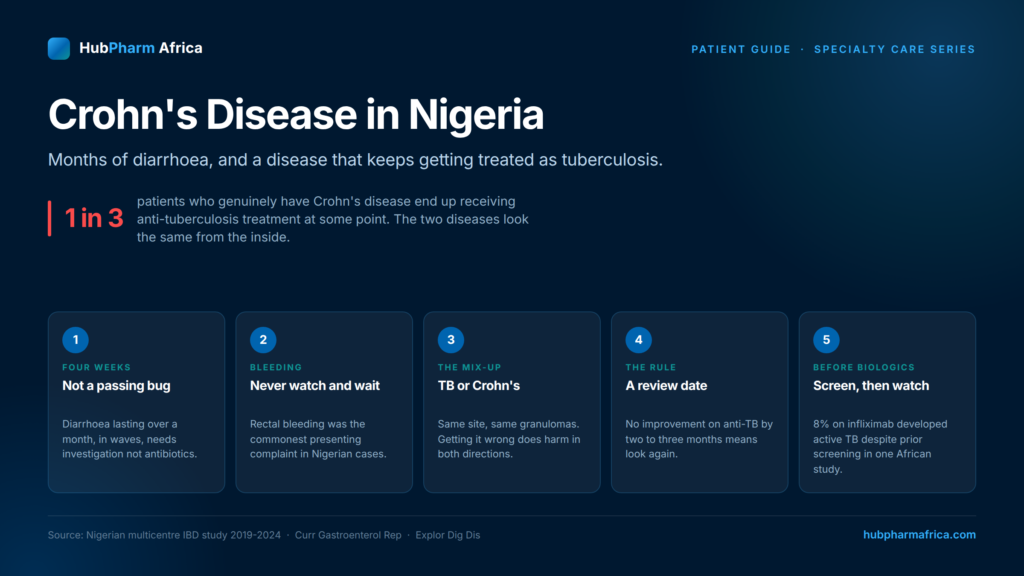
A Nigerian with months of diarrhoea, cramping pain and weight loss usually gets treated for something infectious first. Typhoid, amoebiasis, worms, then tuberculosis. Crohn’s disease in Nigeria therefore tends to reach the right clinic long after the bowel has spent a year or more inflamed, and often after a full course of anti-tuberculosis drugs that never helped.
That sequence is not carelessness. Intestinal tuberculosis genuinely looks like Crohn’s disease, and Nigeria carries a great deal of tuberculosis. So Crohn’s disease in Nigeria is not rare so much as late, and mislabelled along the way. This guide explains what the disease is, why the mix-up happens, how doctors settle it, and what treatment actually involves here.
What Crohn’s disease in Nigeria looks like
It is an autoimmune condition in which the immune system attacks the lining of the digestive tract. Inflammation can appear anywhere from mouth to anus, and it often runs deep through the bowel wall rather than staying on the surface.
The usual symptoms are these.
| Symptom | What it looks like |
| Diarrhoea | Persistent, often for months, sometimes with blood or mucus |
| Abdominal pain | Frequently cramping, classically low on the right side |
| Weight loss | Unintentional, with poor appetite |
| Fatigue | Often from anaemia as much as from the inflammation |
| Fever | Low grade, coming and going |
| Around the anus | Pain, abscesses, fistulas or tags, which point strongly at Crohn’s |
Two features separate this from ordinary food poisoning or an infection. First, it lasts. Diarrhoea for more than four weeks is not a bug you will shake off. Second, it comes back in waves, settling for weeks and then returning.
Nigerian data shows Crohn’s disease in Nigeria striking a younger group than international pages suggest, so a student or a young worker with months of loose stools deserves proper investigation rather than another antibiotic.
Why Crohn’s disease in Nigeria gets mistaken for tuberculosis
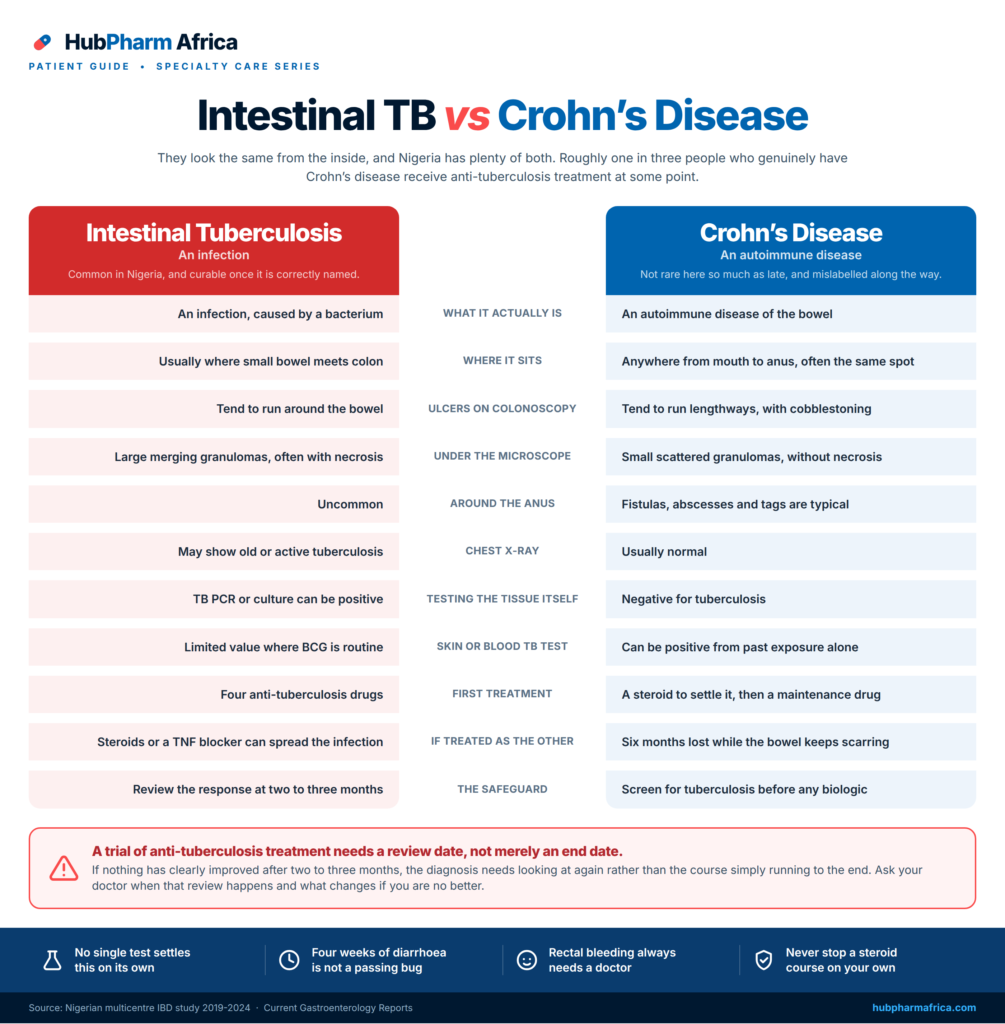
This is the section that matters most, and it is the one no other Nigerian page will give you.
The two diseases look the same from the inside
Crohn’s disease in Nigeria and intestinal tuberculosis are both chronic granulomatous diseases of the bowel. They overlap on symptoms, on scans, on colonoscopy and even under the microscope. Both favour the same part of the gut, where the small bowel joins the colon. Both produce granulomas, so finding one does not settle the question.
The usual tuberculosis tests do not rescue the situation either. Tuberculin skin testing loses much of its value where BCG vaccination is routine, and a positive result only shows exposure rather than active bowel disease. Testing bowel tissue directly for the tuberculosis organism is far more specific, although few Nigerian centres run it.
Consequently, near enough a third of patients who actually have Crohn’s disease end up receiving anti-tuberculosis treatment at some point.
Getting it wrong is dangerous in both directions
Treating tuberculosis as Crohn’s is the worse mistake. Steroids and drugs that block TNF suppress the immune system. Given to someone whose bowel disease is really tuberculosis, they can let that infection spread through the body.
Treating Crohn’s as tuberculosis wastes months. A patient takes four drugs for six months, feels no better, and the inflammation continues quietly damaging the bowel during the whole course.
What good practice looks like here
Nigerian gastroenterologists often start anti-tuberculosis treatment when the picture is genuinely unclear, because the cost of missing tuberculosis is so high. That approach is defensible. However, it comes with a condition attached.
A trial of anti-tuberculosis treatment needs a review date, not merely an end date. If nothing clearly improves after roughly two to three months, the diagnosis needs revisiting rather than the course simply running to the end. Ask your doctor directly when the review will happen and what will change if you are not better.
Ulcerative colitis, the commoner one in Nigeria
Crohn’s has a close relative. Ulcerative colitis inflames only the colon and only the surface lining, and it almost always causes bleeding.
A national study across 18 centres in all six geopolitical zones reviewed more than 4,700 colonoscopies between 2019 and 2024. Among the confirmed cases, ulcerative colitis accounted for 53.9 percent, Crohn’s disease for 21 percent, and 25 percent fitted neither label cleanly.
Two findings from that work deserve attention. Rectal bleeding was the commonest presenting complaint, and inflammation involved the whole colon in 62 percent of cases, which is extensive disease rather than a mild patch.
So blood in the stool is never something to watch for a few months. It needs a doctor, and usually a colonoscopy.
Getting diagnosed
No single test proves Crohn’s disease in Nigeria, or ulcerative colitis either. Instead the diagnosis comes from assembling several.
- Colonoscopy with biopsies. The key test. Biopsies from several segments matter, because the pattern across the bowel is part of the answer.
- Blood tests. Full blood count for anaemia, plus inflammatory markers such as CRP and ESR.
- Stool tests. To exclude infection and parasites, which still need ruling out properly rather than assumed.
- Faecal calprotectin. Separates inflammation from irritable bowel syndrome. Availability varies here.
- Imaging. Scans assess the small bowel, which colonoscopy cannot fully reach.
- Tuberculosis work-up. For the reasons above, this belongs in the process rather than after it.
Colonoscopy is not available in every state, and the cost falls on the patient. Nevertheless, it is the test that changes the answer, so it is worth travelling for.
Treatment that works
Treating Crohn’s disease in Nigeria has two jobs: settle the current flare, then keep the disease quiet afterwards. Painkillers achieve neither.
Aminosalicylates
Mesalazine and related drugs work on the lining of the colon and remain first line for mild to moderate ulcerative colitis. In the national study, roughly 60 percent of patients received them. They do less in Crohn’s disease, where deeper inflammation needs a different approach.
Steroids are a bridge
Prednisolone settles a flare quickly, which is exactly why it gets overused here when better drugs are unavailable. Steroids control symptoms without healing the bowel, and long courses bring diabetes, bone thinning, cataracts and infection.
Never stop a long course of steroids abruptly. Sudden withdrawal can cause adrenal crisis. Any reduction follows a plan agreed with your doctor.
Immunosuppressants
Azathioprine, and sometimes methotrexate, hold the disease down so steroids can come off. They take weeks to months to work and need regular blood counts and liver tests, so budget for the monitoring as well as the medicine.
Biologics, and the tuberculosis problem again
Infliximab and adalimumab block TNF and can transform severe disease. Yet they carry a specific risk here.
A South African study found that 8 percent of inflammatory bowel disease patients treated with infliximab developed active tuberculosis despite being screened for latent infection first. Screening reduces the risk substantially, but it does not remove it in a high burden setting.
Therefore anyone starting a biologic needs screening before the first dose, and vigilance afterwards. Report a persistent cough, night sweats, fever or weight loss immediately rather than waiting for the next appointment.
Living with Crohn’s disease in Nigeria

Food
No diet causes inflammatory bowel disease, and no diet cures it. What food does affect is comfort and nutrition. Many people find fatty, very spicy or heavily fibrous meals worsen symptoms during a flare, then tolerate them again once things settle.
Nutrition matters more than restriction. Iron deficiency anaemia is common, and so are low vitamin B12 and low vitamin D, particularly where the small bowel is involved. Ask your doctor to check all three rather than assuming tiredness is simply part of the illness.
Smoking
Smoking clearly worsens Crohn’s disease, raising flares, surgery and relapse after surgery. Stopping is one of very few things that changes the course of the illness, and it costs nothing.
When to go to hospital
Go straight away for any of these.
- More than six bloody stools a day with fever or a racing pulse
- Severe abdominal pain with a swollen, tender abdomen
- Persistent vomiting and no wind or stool passing
- Dizziness, fainting or heavy rectal bleeding
Common questions
Questions about diagnosis
Is there a cure for Crohn’s disease in Nigeria?
No, although treatment can push it into long remission, where you feel entirely well for years. That remains the goal.
I finished anti-tuberculosis treatment and I am no better. What now?
Go back and say exactly that. Completing a course is not the same as responding to it, and a poor response is itself useful information pointing towards inflammatory bowel disease.
Is it caused by what I eat, or by stress?
Neither causes it. Both can make symptoms feel worse during a flare, which is why the myth persists.
Questions about treatment and daily life
Do I have to stay on treatment when I feel well?
Yes. Maintenance treatment is what keeps you well, and stopping it is the commonest reason a settled disease flares again.
Is surgery a failure?
No. A significant number of people with Crohn’s need surgery at some point, and for the right problem it works well.
Can I have children?
Yes. Fertility is largely normal in quiet disease, and most treatments suit pregnancy, although a few do not. Plan it with your doctor before you start trying.
Does long standing colitis raise cancer risk?
Extensive disease over many years does raise colon cancer risk, which is why doctors recommend surveillance colonoscopy after roughly eight to ten years. Ask when yours is due.
Treating Crohn’s disease in Nigeria is also a supply problem
In that national study, cost and availability of medicines affected close to half of all patients.
Read that again, because it reframes the whole illness. The clinical decisions above are the easy part. What decides outcomes is whether the medicine is genuine, affordable and there again next month.
That is HubPharm Africa’s work. We source verified medicines, deliver across Nigeria, coordinate refills so maintenance treatment does not lapse, and put a pharmacist on the phone when a side effect makes you want to stop. Where a medicine is not routinely stocked here, we tell you honestly whether we can source it and what the lead time looks like, rather than letting you hope. Across our programmes we have seen a 42 percent improvement in medication adherence and 95 percent patient satisfaction.
Crohn’s disease in Nigeria is manageable once somebody names it correctly. Months of unexplained diarrhoea deserve that answer, not another antibiotic.
[Talk to a HubPharm pharmacist →]
⸻
This article is for general information and does not replace advice from your own doctor or pharmacist. Never start, change or stop treatment, including anti-tuberculosis treatment, without speaking to them first.
References
- Inflammatory bowel disease in Nigeria: a multicentre study across 18 centres and six geopolitical zones, 2019 to 2024.
- Inflammatory bowel disease in Africa: the current landscape of pharmacological treatments and the promise of emerging innovations. Exploration of Digestive Diseases.
- Differential diagnosis of Crohn’s disease versus ileal tuberculosis. Current Gastroenterology Reports.
- Inflammatory bowel disease in sub-Saharan Africa: epidemiology, risk factors, and challenges in diagnosis. The Lancet Gastroenterology and Hepatology, 2022.
- Inflammatory bowel disease in Africa: what is the current state of knowledge?