Multiple Sclerosis in Nigeria: Diagnosis and Treatment
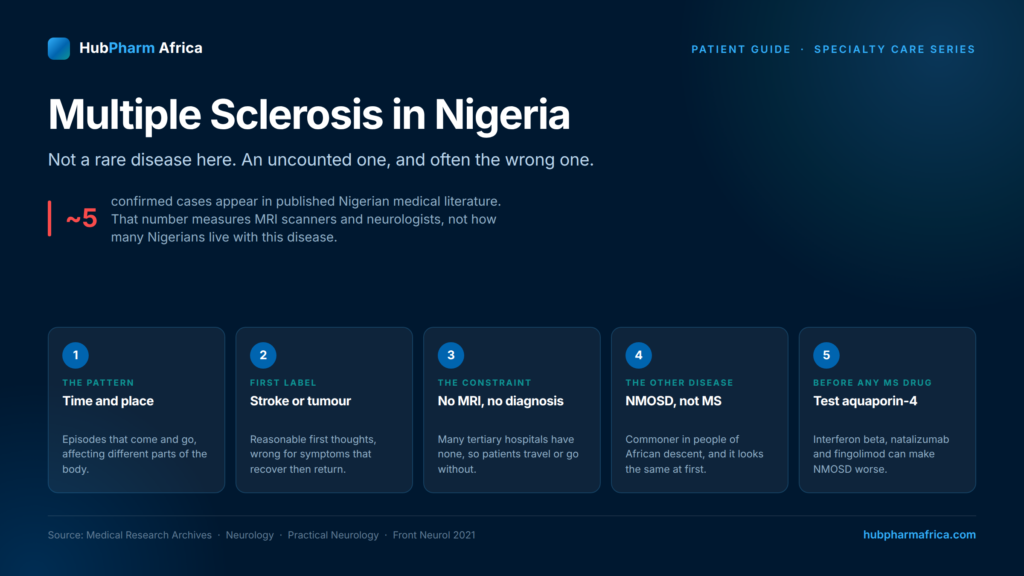
Published Nigerian medical literature contains roughly five confirmed cases of multiple sclerosis. Nobody believes that is the real number. It is simply what happens when a disease can only be diagnosed with an MRI scanner, a neurologist and an antibody test, and a country of more than 200 million has too few of all three.
So multiple sclerosis in Nigeria is not a rare disease. It is an uncounted one. This guide explains what it does, why it gets missed, the very different condition it is frequently confused with, and what treatment realistically looks like here.
What multiple sclerosis in Nigeria looks like
The immune system attacks myelin, the insulating sheath around nerve fibres in the brain, spinal cord and optic nerves. Messages then travel slowly, or not at all, and the symptoms depend entirely on which part of the nervous system is affected.
| Symptom | How it usually appears |
| Vision | Blurring or loss in one eye, often with pain on moving it |
| Numbness or tingling | Face, limbs or trunk, frequently on one side |
| Weakness | Legs more often than arms, with heaviness or dragging |
| Balance | Unsteadiness, dizziness, clumsy hands |
| Bladder | Urgency, frequency, or difficulty emptying |
| Fatigue | Overwhelming, and not explained by effort |
Two patterns matter more than any single symptom. First, episodes come and go. A relapse builds over days, lasts weeks, then improves partly or fully. Second, the episodes affect different parts of the body at different times.
That combination, meaning neurological symptoms separated in both place and time, is what should raise the question of multiple sclerosis in Nigeria as much as anywhere else. A young adult, most often a woman, with an episode of visual loss last year and numb legs this year has a pattern worth investigating properly.
Why multiple sclerosis in Nigeria goes unrecognised
The old belief that Africans do not get it
For decades textbooks taught that multiple sclerosis was a disease of temperate climates and white populations. That belief shaped who got investigated, so cases went unlooked for and the absence of cases then seemed to confirm the belief.
Reported rates across sub-Saharan Africa do run well below European and North American figures. However, a Lagos series found multiple sclerosis in 1.26 of every 1,000 neurological cases seen, with women outnumbering men roughly three to one, which matches the international pattern exactly.
It gets called a stroke or a tumour
New multiple sclerosis in Nigeria is frequently labelled as stroke or as a brain tumour on first presentation. Both are reasonable first thoughts for sudden neurological symptoms in an adult. Yet a young person with weakness that improves over weeks and then returns somewhere else is not behaving like either.
Spinal tuberculosis, HIV-related nerve disease and vitamin B12 deficiency also enter the picture here, and all of them deserve excluding properly rather than assuming. Each of them is commoner than multiple sclerosis in Nigeria, which is precisely why the rarer diagnosis keeps getting overlooked.
No MRI, no diagnosis
This is the hard constraint. MRI is essential, and many Nigerian tertiary hospitals still have none. Patients therefore travel, pay privately, or go without.
Furthermore, a scan alone is not enough. Interpreting demyelinating lesions needs a radiologist and a neurologist who see such cases, and the country has very few of either.
The disease that gets mistaken for MS
This section is the most important on the page, and it applies specifically to African patients.
NMOSD is commoner in people of African descent
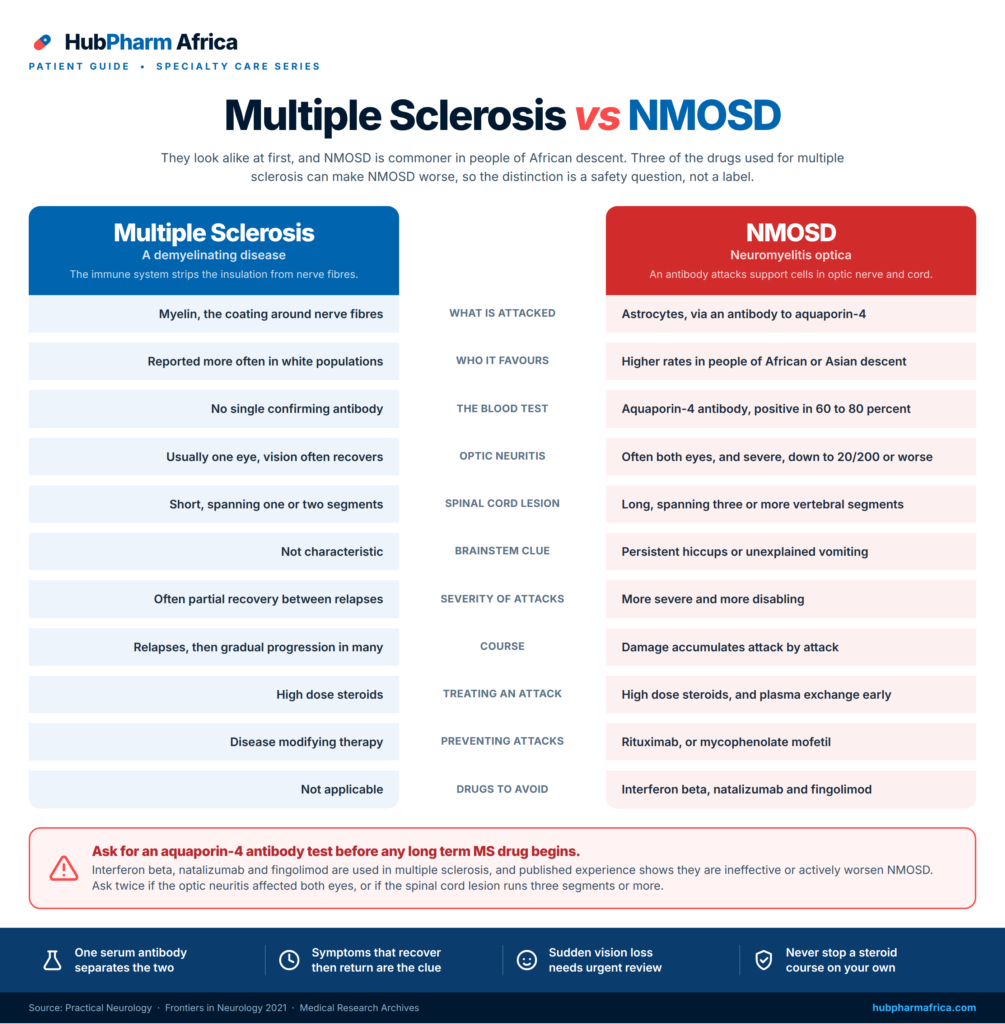
Neuromyelitis optica spectrum disorder, usually shortened to NMOSD, attacks the optic nerves and the spinal cord. It looks like multiple sclerosis at first glance. Nevertheless it is a different disease, driven by an antibody against a water channel protein called aquaporin-4, and it occurs at higher rates among people of African or Asian descent than among white populations.
Several features point towards it rather than MS.
- Optic neuritis in both eyes at once, or severe visual loss down to 20/200 or worse
- Spinal cord inflammation running three or more vertebral segments on MRI
- Attacks that are more severe and more disabling than typical MS relapses
- Persistent hiccups or vomiting from a brainstem lesion
Three MS drugs make NMOSD worse
Here is why the distinction is not academic. Interferon beta, natalizumab and fingolimod are used in multiple sclerosis, and published experience shows they are ineffective or actively worsen NMOSD. Specialists therefore avoid them in anyone with NMOSD.
A Nigerian patient labelled with multiple sclerosis, started on interferon beta, who actually has NMOSD is taking a drug that can make their disease worse. Given that NMOSD is relatively commoner in this population, the risk here is not theoretical.
One blood test changes the plan
The aquaporin-4 antibody, tested on a serum sample using a cell-based assay, is positive in roughly 60 to 80 percent of people with NMOSD. It is the single test that separates the two conditions.
Ask for it before any long-term MS drug starts. If the picture includes severe or bilateral optic neuritis, or a long spinal cord lesion, ask for it twice.
Treatment differs too. Acute NMOSD attacks need intravenous methylprednisolone and often plasma exchange quickly, while relapse prevention usually means rituximab, or mycophenolate mofetil where rituximab is unsuitable.
How the diagnosis is made
No single test proves multiple sclerosis in Nigeria or anywhere else. Instead neurologists assemble a picture.
- Clinical history. Episodes separated in time and in location within the nervous system.
- MRI of brain and spinal cord. The central test, showing lesions and their pattern.
- Aquaporin-4 antibody, and often MOG antibody. To exclude the conditions above.
- Lumbar puncture. Looking for oligoclonal bands, which support the diagnosis.
- Blood tests. To rule out B12 deficiency, HIV, syphilis, lupus and thyroid disease, all of which can imitate it.
- Evoked potentials. Sometimes used to detect slowed conduction in the optic nerve.
Treating multiple sclerosis in Nigeria
Treatment has three separate parts, and people frequently receive only the first.
Treating a relapse
A significant relapse is usually treated with a short course of high dose steroids, which shortens the attack. Steroids do not change the long-term course, and they are not a substitute for the next part.
Never stop a steroid course abruptly on your own. Reductions follow a plan agreed with your doctor. Steroids remain the most available treatment for multiple sclerosis in Nigeria, and also the most overused.
Disease modifying therapy
These drugs reduce how often relapses happen and how much disability accumulates. They are the part that changes the future, and they are the part hardest to obtain here. Annual costs run far beyond what most Nigerian families can meet, and no routine insurance covers them.
Consequently many people with multiple sclerosis in Nigeria are managed on steroids for attacks and nothing in between. That is not good medicine, and saying so plainly is more useful than pretending the gap does not exist. Ask your neurologist about manufacturer access programmes, about generics and biosimilars where they exist, and about which therapy is realistic rather than which is ideal.
Managing the symptoms
This part is affordable and frequently neglected. Physiotherapy preserves walking. Bladder problems respond to treatment. Spasticity, nerve pain, fatigue and low mood all have specific management, and addressing them changes daily life more quickly than anything else on this page.
Living with it day to day
Heat makes symptoms worse temporarily. In Nigerian conditions this matters. Overheating can blur vision or weaken legs for a few hours, which frightens people who think they are relapsing. Cool down, rehydrate, and reassess.
Infections trigger relapses. Urinary infections in particular. Treat them early rather than waiting.
Vitamin D is worth checking. Low levels are associated with multiple sclerosis, and deficiency is common even in sunny countries once people work indoors and cover up.
Keep a simple record. Date, symptom, how long it lasted. Continuity of care is fragile when clinics and doctors change, and your own notes often become the most complete file that exists.
Common questions
Is multiple sclerosis fatal?
Most people have a near normal lifespan. Disability accumulates in some and barely at all in others, which is exactly why treatment between relapses matters.
Can it be cured?
No. Treatment reduces relapses and slows progression, and many people remain fully independent for decades.
Is it inherited?
Risk rises slightly if a close relative has it, although most people with multiple sclerosis have no family history whatsoever.
Why does everyone mention stroke first?
Because sudden weakness or visual loss in an adult looks like stroke. The difference is in the pattern over time, so tell your doctor about every past episode, including ones that got better.
Questions about treatment and daily life
Can I work?
Most people can, often for many years. Fatigue is usually the limiting factor rather than weakness, and adjusting hours or duties helps more than stopping.
Can I have children?
Yes. Relapses commonly reduce during pregnancy and rise for a few months afterwards. Some treatments are unsuitable in pregnancy, so plan it with your neurologist in advance.
Does diet cure it?
No diet cures multiple sclerosis. Eating well, staying active and stopping smoking all help, and smoking specifically worsens the course.
Should I take steroids at the first sign of anything?
No. Brief symptoms that pass within a day are frequently heat or fatigue rather than a relapse. Steroids are for genuine relapses, judged with your doctor.
Treating multiple sclerosis in Nigeria is also a supply problem
The clinical decisions in this article are the straightforward part. What decides outcomes is whether a person can get the scan, the antibody test and then the medicine, month after month, in a country where all three are scarce.
That is where HubPharm Africa works. We source verified medicines, deliver across Nigeria, coordinate refills so treatment does not lapse, and put a pharmacist on the phone when a side effect makes you want to stop. When Nigerian pharmacies do not routinely stock a medicine, we tell you honestly whether we can source it, how long it will take and what handling it needs, rather than letting you hope.. Across our programmes we have seen a 42 percent improvement in medication adherence and 95 percent patient satisfaction.
Five published cases is a measure of our diagnostic capacity, not of how many Nigerians are living with this disease.
[Talk to a HubPharm pharmacist →]
⸻
This article is for general information and does not replace advice from your own doctor, pharmacist or neurologist. Never start, change or stop treatment on your own.
References
- Multiple sclerosis in sub-Saharan Africa: review of current trends and available literature. Medical Research Archives.
- Unveiling multiple sclerosis in Nigeria: the conundrum of diagnosis and access to disease modifying therapies. Neurology.
- Neuromyelitis optica spectrum disorders. Practical Neurology.
- MRI patterns distinguish AQP4 antibody positive neuromyelitis optica spectrum disorder from multiple sclerosis. Frontiers in Neurology, 2021.
- Differentiating multiple sclerosis from AQP4 neuromyelitis optica spectrum disorder and MOG antibody disease with imaging.