Autoimmune Disease in Nigeria: Why Diagnosis Takes Years
Ask a Nigerian with lupus how long it took to get diagnosed and you will usually hear a story rather than a number. Months of fevers treated as malaria. A rash blamed on soap. Joint pain that came and went for two years. Then finally, often after someone travelled to Lagos or Ibadan, a name for it.
Autoimmune disease in Nigeria is not rare. It is late, and it is poorly counted. This guide explains why the delay happens, what treatment actually involves, and the two safety points that matter more here than anywhere the international guidelines were written.
What autoimmune disease in Nigeria looks like from the inside
Understanding autoimmune disease in Nigeria starts with the specialist gap, because everything else follows from it.
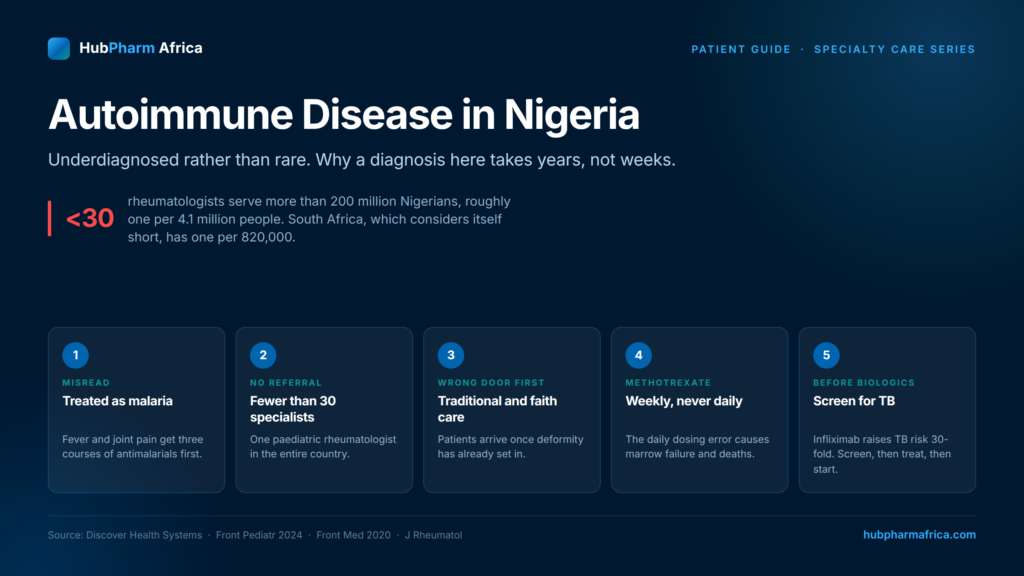
Nigeria has fewer than 30 rheumatologists for a population above 200 million. That works out at roughly one for every 4.1 million people, and almost all of them practise in a handful of urban centres. For comparison, South Africa has about one rheumatologist per 820,000 people, and that country considers itself short.
Paediatrics is worse. As of 2024 Nigeria had one formally trained paediatric rheumatologist, and among 36 states only Lagos ran a dedicated paediatric rheumatology service.
So a child in Sokoto with juvenile arthritis, or an adult in Yola with early lupus, is not competing for a scarce appointment. In practical terms the appointment does not exist within a day’s travel.
What the clinics that do exist actually see
The rheumatology unit at Irrua Specialist Teaching Hospital has managed 1,658 patients since 2016. Osteoarthritis accounted for 51.9 percent, systemic lupus erythematosus for 9.9 percent and rheumatoid arthritis for 8.1 percent.
Those proportions matter. Lupus was not a curiosity in that clinic. It was the second commonest diagnosis.
Why autoimmune disease in Nigeria takes years to diagnose
1. The symptoms look like the things we test for first
Fever, joint pain, fatigue and weight loss are the opening symptoms of lupus, vasculitis and several other autoimmune conditions. They are also the opening symptoms of malaria and typhoid, which is what a Nigerian patient gets treated for, often repeatedly.
Consequently, a person can complete three or four courses of antimalarials before anyone asks why the fevers keep returning. Suspicion should rise when treatment does not work and the pattern keeps repeating.
2. There are almost no specialists to refer to
The shortage above compounds everything else. General practitioners who suspect an autoimmune condition frequently have nowhere to send the patient, so the suspicion quietly dies.
3. Traditional and faith-based treatment usually comes first
Nigerian rheumatology teams describe the same pattern repeatedly: patients arrive after seeking help from traditional or faith healers, and present only once deformity or serious disability has set in. By then joint damage is permanent and the window for changing the course of the disease has closed.
Nobody living with autoimmune disease in Nigeria should be judged for that sequence. Cost, distance and the absence of any alternative drive it. However, the earlier a rheumatologist sees you, the more of your joints you keep.
4. The tests are expensive and often unavailable
Antinuclear antibody testing, anti-dsDNA, complement levels, rheumatoid factor and anti-CCP are not routinely available outside major centres, and the cost falls on the patient. Meanwhile MRI, which diagnoses multiple sclerosis, is available in relatively few facilities nationwide.
5. The old belief that Africans do not get these diseases
For decades the literature genuinely asked whether lupus was rare in West Africa. One well known paper framed it as a question: a rarity, or a yet to be investigated entity.
That question now looks answered. A systematic review found pooled SLE prevalence of 1.7 percent among 28,575 patients attending internal medicine and rheumatology units across African countries, and reviewers note that hospital based reporting understates true frequency by roughly six to ten fold against population studies. Pooled mortality across those African cohorts reached 10.3 percent, driven by infection, kidney disease, neurological involvement and flares.
In other words, autoimmune disease in Nigeria was always here. The counting was not.
The conditions this covers
| Condition | What it affects | Common treatments |
| Rheumatoid arthritis | Joints, symmetrically | Methotrexate, hydroxychloroquine, biologics |
| Systemic lupus erythematosus | Skin, joints, kidneys, blood, brain | Hydroxychloroquine, steroids, mycophenolate |
| Multiple sclerosis | Brain and spinal cord | Interferon beta, glatiramer, oral agents |
| Crohn’s disease and ulcerative colitis | Gut | Aminosalicylates, azathioprine, biologics |
| Psoriasis and psoriatic arthritis | Skin and joints | Topicals, methotrexate, biologics |
| Myasthenia gravis | Nerve to muscle signalling | Pyridostigmine, steroids, immunosuppressants |
| Vasculitis | Blood vessels | Steroids, cyclophosphamide, rituximab |
| Autoimmune thyroid disease | Thyroid gland | Levothyroxine, carbimazole |
The tuberculosis rule that matters more in Nigeria than anywhere
This section is the most important thing on the page.
Biologic medicines that block TNF, meaning adalimumab, infliximab and etanercept, transformed the treatment of rheumatoid arthritis, psoriasis and inflammatory bowel disease. They also reactivate dormant tuberculosis.
The size of that effect is not subtle. One study found patients with rheumatoid arthritis on infliximab carried a 30.1 fold higher risk of tuberculosis than the general population, against 8.9 fold for people with untreated rheumatoid arthritis. Monoclonal antibodies such as adalimumab and infliximab carry more risk than etanercept.
Now place that in a country with one of the highest tuberculosis burdens in the world, where a large share of adults carry latent infection without knowing it.
What has to happen before the first dose
International guidance is consistent, and it is not optional.
- Screening for latent tuberculosis before starting, using a tuberculin skin test and an interferon gamma release assay where available, since BCG vaccination complicates the skin test alone
- A chest X-ray
- Assessment of other risk factors, including HIV status, diabetes and previous TB exposure
- If latent TB is found, treatment starts first. Guidance is to begin the biologic one to two months after starting preventive treatment, using isoniazid for six to nine months or rifampicin for four
If a Nigerian doctor offers you a TNF blocker and nobody has mentioned tuberculosis, ask about it before you accept the prescription. That single question is the most valuable thing in this article.
How autoimmune disease in Nigeria is treated
Disease modifying drugs come first
Methotrexate, hydroxychloroquine, sulfasalazine, azathioprine and mycophenolate suppress the immune attack rather than merely easing symptoms. They work slowly, often taking six to twelve weeks, which leads many people to abandon them early believing they do nothing.
Methotrexate is weekly, never daily
This deserves its own heading because the error kills people.
Methotrexate for autoimmune disease is taken once a week, on the same named day. Taken daily by mistake it causes severe bone marrow suppression, mouth ulceration and gut damage, and people have died from exactly this error.
Therefore write the day on the box. Tell whoever collects your medicines. Check the label every single time, especially when the brand or the pharmacy changes. Most people also take folic acid on a different day to reduce side effects.
Steroids, and the rule about stopping
Prednisolone controls inflammation quickly and is often used while slower drugs take effect.
Never stop long term steroids suddenly. After several weeks of treatment the body reduces its own cortisol production, and abrupt withdrawal can cause adrenal crisis, which is life threatening. Any reduction is tapered under supervision, however well you feel.
Biologics, and getting hold of them
Biologics have transformed outcomes in rheumatoid arthritis, psoriasis and inflammatory bowel disease. For autoimmune disease in Nigeria, however, the limiting factor is rarely the prescription. It is supply, cold chain and continuity, since several of these products require storage between 2 and 8 degrees and lose potency if that chain breaks.
Interrupted biologic treatment is not merely a pause. It can allow the disease to flare and, with some agents, allow antibodies to develop that make the drug stop working permanently.
When to seek help urgently
Treatment for autoimmune disease in Nigeria changes what counts as an emergency, because immunosuppression blunts the usual warning signs. Go to hospital for any of these.
- Fever while taking immunosuppressants, which needs same day assessment because infection can escalate quickly
- New breathlessness, chest pain or coughing blood
- Sudden weakness, numbness, confusion, seizures or a severe new headache
- Difficulty swallowing or breathing in myasthenia gravis, which can indicate a myasthenic crisis
- Frothy urine, blood in urine or sudden swelling of the legs and face, which can indicate kidney involvement in lupus
- A rapidly spreading rash, or blistering and peeling skin
Common questions
Questions about diagnosis
How do I find a rheumatologist in Nigeria?
Ask your doctor for a referral to a teaching hospital rheumatology unit. Lagos, Ibadan, Ile-Ife, Benin, Irrua, Abuja, Enugu and Kano have services of varying size. Expect to travel, and take every previous test result with you.
Is autoimmune disease in Nigeria really as common as elsewhere?
The honest answer is that nobody knows precisely, because the counting infrastructure barely exists. What the evidence does show is that these conditions are present, that hospital figures understate them substantially, and that the delay to diagnosis is long. Underdiagnosis rather than rarity is the better description.
Which tests should I ask for?
That depends entirely on what is suspected, so it is a conversation with a doctor rather than a shopping list. Bring a written timeline of your symptoms, because in autoimmune disease the pattern over months carries more information than any single test.
Questions about treatment and daily life
Can autoimmune disease in Nigeria be cured?
Not currently. Remission, meaning the disease becomes quiet and stays quiet, is a realistic goal for many people and is what treatment aims at. Stopping medication because you feel well is the commonest route back to a flare.
Is it safe to take these medicines long term?
Generally yes, with monitoring. Most disease modifying drugs need periodic blood tests to check the blood count, liver and kidneys. The risks of untreated inflammation are considerably greater than the risks of well monitored treatment.
Can I take herbal preparations alongside my medicines?
Tell your pharmacist what you take rather than deciding alone. Some preparations affect the liver, which matters a great deal on methotrexate, and some alter how prescribed drugs are cleared. The danger is substitution and silence rather than the plants themselves.
What about pregnancy?
Several of these medicines, notably methotrexate and mycophenolate, are unsafe in pregnancy and require planning well in advance. Others, including hydroxychloroquine, are usually continued. Raise it early, before conception, not afterwards.
Autoimmune disease in Nigeria is underdiagnosed, not rare
The pattern across every form of autoimmune disease in Nigeria is the same. The disease arrives quietly, gets attributed to something commoner, wanders through traditional and general care for months or years, and is finally named by one of fewer than thirty specialists. By then some of the damage is permanent.
Two things change that. Earlier suspicion, which is what this article is for. And reliable supply once treatment starts, which is what HubPharm Africa is for.
Our specialist sourcing team works on the medicines behind these conditions, from methotrexate and hydroxychloroquine through to biologics and factor concentrates, with cold chain handling where products require it and refill coordination so that treatment does not lapse between crises. We will tell you plainly what we can and cannot obtain, because an accurate answer is worth more to you than an encouraging one.
If you have a diagnosis and the supply keeps failing, or you suspect something nobody has yet named, talk to us.
[Tell us what you need →]
⸻
Written by Fawzi Rufai, Medically reviewed by Pharm. Sesan Kareem, B.Pharm, MPA, MBA.
This article is for general information and does not replace advice from your own doctor. Never start, change or stop immunosuppressant or steroid treatment without speaking to the team looking after you.
References
- Rheumatology practice in a rural Nigerian hospital: challenges, adaptations, and lessons. Discover Health Systems.
- Paediatric rheumatology in Nigeria: history, challenges and the future. Frontiers in Pediatrics, 2024.
- Systemic lupus erythematosus in Africa: prevalence, underdiagnosis and outcomes. Frontiers in Medicine, 2020.
- Epidemiology of rheumatic and musculoskeletal diseases in a Nigerian peri-urban community: COPCORD stage 1. Reumatologia.
- Diagnosis of Latent Tuberculosis and Prevention of Reactivation in Rheumatic Patients Receiving Biologic Therapy: International Recommendations. The Journal of Rheumatology.
- Screening, prophylaxis, and challenges: Tumor necrosis factor inhibitors and latent tuberculosis infection nexus in rheumatology. International Journal of Rheumatic Diseases, 2024.