Living with ADHD: Daily Strategies That Work
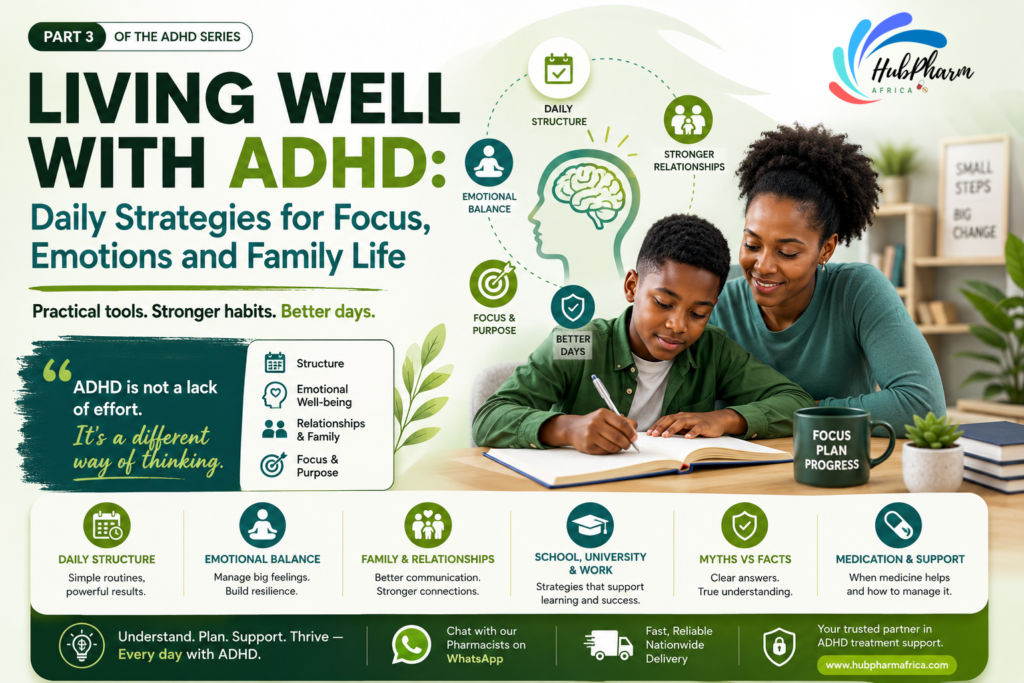
Living with ADHD: Daily Strategies for Focus, Emotions and Family Life
Faizah knows the drill by heart. Her son Soliu will be halfway out the door for school, shoe on one foot, backpack forgotten by the sofa. She used to think he was being careless. Now, three years into his diagnosis, she keeps a checklist taped to the front door at his eye level, and mornings run smoother than they ever did before. That small taped-up list is really the whole story of living with ADHD. It is not about trying harder. It is about building a life around how your brain actually works.
This is the third article in HubPharm Africa’s four-part ADHD series. Our first piece, ADHD Explained, covered what ADHD is. The second, our guide to ADHD medication in Nigeria, walked through treatment options. This one covers what matters day to day: routines, emotions and relationships. Part four turns to sleep, nutrition, medication and life in Nigeria.
If you or someone in your family has ADHD, here is the short version: it can be managed. Not cured, not outgrown in every case, but managed well enough that plenty of people with ADHD run businesses, raise children, pass exams and hold down demanding careers.
Why Living with ADHD Feels Different for Every Person
No two people with ADHD struggle with the same things. One adult might sail through deadlines but forget every birthday. A child might focus for hours on a Lego set and fall apart trying to sit through twenty minutes of homework.
This happens because ADHD affects the brain’s executive function system, the mental skills that handle planning, working memory, impulse control and emotional regulation. It is not a single switch that is either on or off. It is more like a set of dials, and everyone’s dials sit differently, which is why generic advice so often fails.
Building Daily Structure That Sticks
Many people with ADHD experience “time blindness,” a real difficulty sensing how much time has passed or how long a task will take. Visible clocks, alarms set at the start of a task rather than the end, and breaking a two-hour assignment into four visible 30-minute chunks all help more than willpower does. A lot of Nigerian families already do a version of this, tying tasks to prayer times or radio programmes as anchor points.
Forgetfulness is a working-memory issue, not laziness. One landing zone for keys and cards, open shelving instead of closed cabinets, and a single notebook or app for tasks all reduce how much a person has to hold in their head.
Distraction is not about lacking discipline. Brains with ADHD often show lower activity in regions that filter out irrelevant stimulation, so a phone buzz can pull attention as hard as the actual task. Short work bursts with built-in breaks, silenced notifications, and noise-cancelling headphones or earplugs all help.
Impulsivity is the gap between “I thought of it” and “I did it” being shorter than usual. A rule of sitting on an angry text for an hour, or sleeping on any purchase above a set amount, closes that gap without requiring more willpower.
The Emotional Side of ADHD
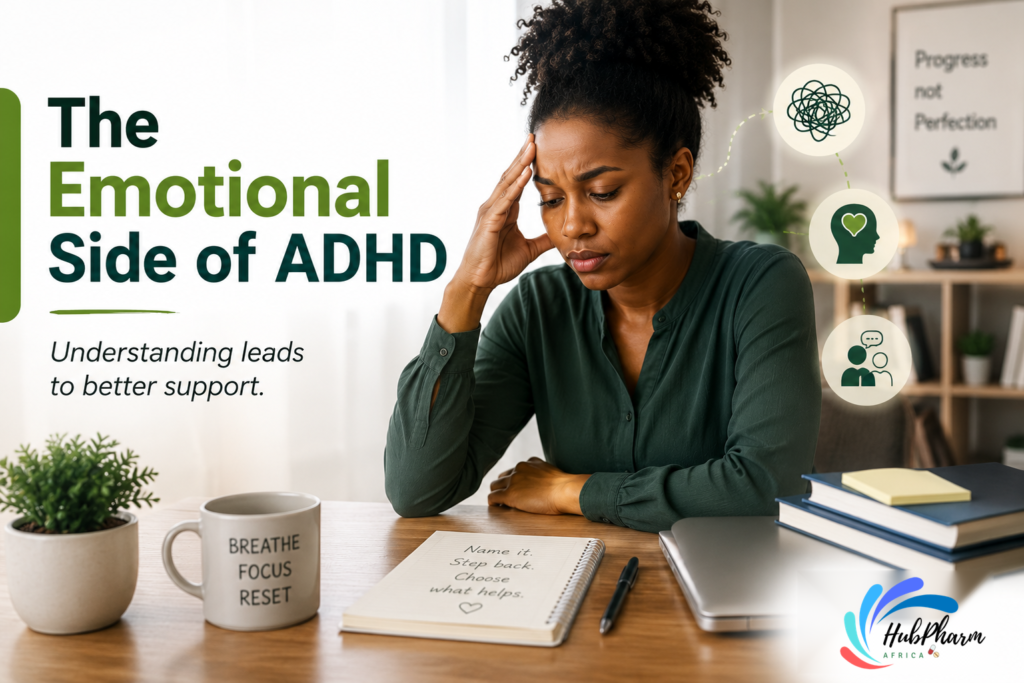
Many clinicians now see emotional regulation difficulty as just as central to ADHD as attention itself. Frustration can arrive fast and hot, and take longer to settle, which is a nervous system pattern, not a bad temper. Naming the feeling out loud and stepping away for a few minutes before responding both help.
Anxiety and depression show up alongside ADHD more often than expected. Years of missed deadlines and being labelled “lazy” take a real toll, and that toll can deepen into genuine anxiety or low mood over time. That deserves its own conversation with a doctor, separate from ADHD itself.
Many adults describe years of hearing they were not trying hard enough, only to be diagnosed in their thirties or forties. Rebuilding confidence usually starts with the same insight Faizah reached with her son: the problem was never effort, it was strategy.
ADHD in Relationships and Family Life
Living with a partner who has ADHD brings specific friction: forgotten anniversaries, unfinished chores, conversations that trail off. Naming the pattern as a shared project, using a shared calendar, and making specific requests instead of vague ones (“take the bins out Tuesday and Friday,” not “help more”) all ease that friction.
Parenting a child with ADHD in Nigeria often comes with extra weight: relatives who insist the child “just needs discipline,” teachers who read fidgeting as disrespect. Children generally respond better to short, immediate instructions than long explanations, and consistent routines with predictable consequences build cooperation over time.
Teenagers manage more independence and more self-consciousness right when fitting in matters most. Involving them in their own management plan, rather than imposing rules from outside, makes a strategy far more likely to stick.
ADHD at School, University and Work
Nigerian classrooms are often large and exam-focused. Preferential seating, breaking assignments into smaller written steps, and short movement breaks help without needing special equipment. University removes the structure of a timetable, so weekly milestones and a visible wall planner close that gap.
Adults with ADHD often do best in roles with variety and autonomy, and struggle in repetitive, low-stimulation jobs. Written task lists, early reminders, and honest conversations with a manager can turn a chaotic-feeling role into one that plays to real strengths.
Common Myths About Living with ADHD
Myth: People with ADHD just need to try harder.
Reality: ADHD involves measurable differences in brain structure and chemistry, not a shortage of willpower.
Myth: Someone who can focus intensely on something they enjoy cannot really have ADHD.
Reality: This is hyperfocus, one of the more recognisable features of ADHD. The issue is inconsistent attention, not an inability to concentrate.
Myth: ADHD is caused by bad parenting or too much screen time.
Reality: ADHD is a neurodevelopmental condition with strong genetic links. Parenting and screen habits affect how symptoms show up day to day, but do not cause the condition.
Medication Management
Medication and the strategies above work best as a team, not as alternatives. If a doctor has prescribed medication, take it exactly as directed, and route any changes through that doctor rather than deciding alone at home. Our detailed guide to ADHD medication in Nigeria covers stimulant and non-stimulant options in full, and part four returns to medication alongside sleep and nutrition.
HubPharm Africa’s pharmacists are available on WhatsApp for medication counselling and adherence support.
This article is educational and does not replace individualised medical advice.
Simple Ways to Start Today
- Pick one landing zone by your front door for keys, cards and transport money
- Break your next big task into pieces small enough to finish in twenty-five minutes
- Replace one vague household request with one specific, scheduled one this week
- Ask a teenager or child what strategy would actually help them, before deciding for them
- If medication has been prescribed, set a daily reminder for the exact same time each day
Frequently Asked Questions
Can adults be successful with ADHD? Yes. Many build thriving careers, particularly in roles that reward creativity and quick thinking. Structure and support make the difference between struggling with ADHD and working well alongside it.
Can someone with ADHD have a healthy marriage? Yes. Couples who name ADHD as a shared challenge, use shared calendars, and make specific requests tend to navigate it well.
Why does a child with ADHD focus for hours on some things but not others? This is hyperfocus. The issue is inconsistent attention regulation, not selective effort.
Does ADHD cause anxiety and depression? Not directly, but the two show up together often, and deserve their own conversation with a doctor.
Where can I get support for ADHD medication questions in Nigeria? HubPharm Africa’s pharmacist-led team can be reached on WhatsApp at +234 705 050 5001, or through the online pharmacy.
The Next Step
Faizah’s checklist did not appear overnight. It took a few weeks of noticing what actually helped Soliu and dropping what didn’t, the same trial and error every family in this situation goes through. Structure, steadier emotions and stronger relationships are the groundwork. In part four, we turn to the body: sleep, nutrition, exercise, supplements, and medication, along with an honest look at what living with ADHD looks like in Nigeria.
Author
Kelvin is a Physiology graduate from the prestigious University of Ilorin, with a background spanning health science, therapy, and health communications. As Content creation Lead at HubPharm Africa, he brings a science-informed perspective to making health information accessible, accurate, and engaging. You can share your perspectives and/or feedback with Kelvin at kelvin@hubpharmafrica.com