ADHD Medication in Nigeria: Types, Costs & Safety in Nigeria
ADHD Medication in Nigeria: Types, Benefits, Side Effects, Costs and Where to Find Genuine Medicine
Your doctor says the word ADHD, writes something on a prescription pad, and suddenly you are holding a piece of paper with a medication name you have never heard of: Ritalin. Concerta. Strattera. Now what? Is it safe? Will it change your child? Will you even find it in any pharmacy near you?
If those questions are spinning in your head, you are in good company. ADHD medication is one of the most misunderstood subjects in Nigerian healthcare, wrapped in fear, gossip, and a lot of wrong information. Some parents refuse it outright because “na hard drug.” Some adults quietly search for it online and end up buying something fake. And many people give up after two weeks because nobody told them how the medicine actually works.
This guide clears the fog. If you read our first article, ADHD Explained: Symptoms, Causes and Support in Nigeria, this is the natural next step. If you are starting here, you will still get everything you need. By the end, you will understand the main types of ADHD medicine, what they do inside the brain, the real side effects, what they cost, and how to find genuine medication you can trust.
One thing first. Medicine is powerful, but it is not the whole answer. Hold that thought, because we come back to it.
Why ADHD Medication Is Used in the First Place
ADHD is not laziness or bad home training. It is a difference in how the brain manages attention, impulse, and activity. In many people with ADHD, certain brain chemicals that help you focus and pause before acting run a little low in the areas that matter most.
Medication helps top up those chemicals. When it works well, a restless child can sit through a lesson. An adult who used to miss deadlines starts finishing tasks. A student who read the same paragraph five times finally holds the meaning.
The evidence here is strong. Roughly 70 to 80 percent of children with ADHD respond well once the right medicine and dose are found, according to Cleveland Clinic. That is a high success rate for any treatment in medicine.
How ADHD Medicines Work, in Plain Language
Here is the part that surprises most people. Despite the name, stimulant medicines do not “hype up” a person with ADHD. They calm the noise.
Think of the ADHD brain like a radio that keeps losing the station. Thoughts jump. Focus slips. The medicine steadies the signal by raising two brain messengers called dopamine and norepinephrine. These messengers help you pay attention, stay motivated, and think before you act.
So the child who seemed to have “too much energy” often becomes calmer, not more wired. That single fact clears up years of confusion for many families.
Medicine Is One Part of the Plan, Not the Whole Plan
Before we go deeper, a truth worth repeating. Medication manages symptoms while you take it. It does not teach skills, fix routines, or replace support at home and school.
For young children under six, experts actually recommend behaviour therapy and parent training first, before any medicine is tried, because young children get more side effects and the training works just as well. For older children and adults, the best results usually come from medicine plus behaviour strategies working together.
We will cover those strategies fully in the next article. For now, remember that the tablet is a tool, not a cure.
The Two Main Families of ADHD Medication
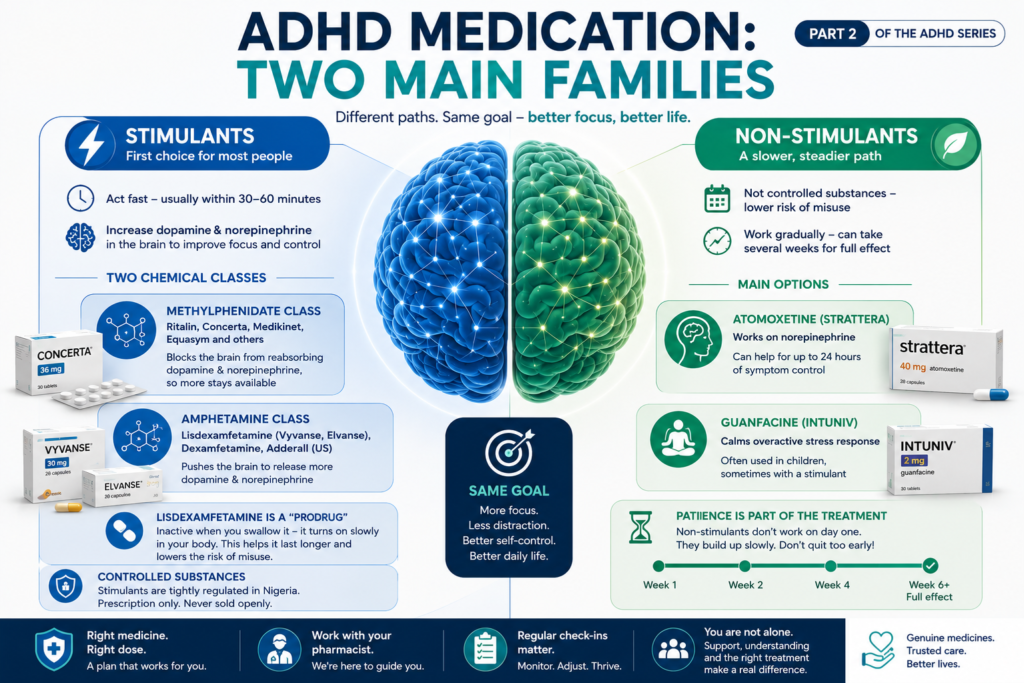
Almost every ADHD medicine falls into one of two groups: stimulants and non-stimulants. Understanding the difference is more useful than memorising drug names.
Stimulants: The First Choice for Most People
Stimulants have been used for ADHD since the 1960s and remain the most studied and most effective option for most patients. They act fast, often within 30 to 60 minutes, and they split into two chemical classes.
Methylphenidate class. This includes brands you may hear locally or from relatives abroad, such as Ritalin, Concerta, Medikinet, and Equasym. Methylphenidate mainly works by blocking the brain from mopping up dopamine and norepinephrine too quickly, so more stays available where you need it.
Amphetamine class. This includes lisdexamfetamine (brand names Vyvanse and Elvanse), dexamfetamine, and Adderall, which is common in the United States and mentioned here only for comparison. These push the brain to release more of the same messengers.
Here is a second surprising fact. Lisdexamfetamine is what pharmacists call a “prodrug.” It is inactive when you swallow it and only turns on after your body slowly converts it. That built-in delay is part of why it lasts long through the day and is harder to misuse.
One important note. Stimulants are controlled substances everywhere, including Nigeria. That means they are tightly regulated, prescription only, and never sold openly on a shelf like paracetamol.
Non-Stimulants: A Slower, Steadier Path
Non-stimulants were made for the 15 to 30 percent of people who do not respond well to stimulants or cannot tolerate the side effects. They are not controlled substances, so the misuse risk is lower.
The main ones are atomoxetine (Strattera), which works on norepinephrine and can cover symptoms for up to 24 hours, and guanfacine (Intuniv), which calms an overactive stress response and is often used in children, sometimes alongside a stimulant.
Now the third fact many families wish they had known earlier. Non-stimulants do not work on day one. They build up gradually and can take several weeks to reach full effect. Plenty of people quit after a week thinking the drug failed, when it simply had not started yet. Patience is part of the treatment.
Short-Acting Versus Long-Acting: Why Timing Matters
Stimulants come in two release styles, and the choice affects daily life more than people expect.
Short-acting (immediate-release) versions work quickly but wear off in a few hours, so a person may need more than one dose a day. Long-acting (extended-release) versions release the medicine slowly and can last most of the school or work day from a single morning dose.
Long-acting options reduce the “ups and downs” through the day and remove the awkward need to take a tablet at school or in the office. For a shy teenager who does not want classmates to know, that privacy can matter a lot. Sometimes a doctor combines a long-acting morning dose with a small short-acting top-up in the afternoon.
Benefits and Honest Limitations
The benefits are real. Better focus, calmer behaviour, fewer impulsive mistakes, improved school and work performance, and often better relationships because the person is no longer constantly forgetting, interrupting, or running late.
The limits are just as real. Medication does not work every hour of the day, especially short-acting types. It does not build organisation skills by itself. Not everyone responds to the first medicine, and finding the right fit can take a few adjustments. And it does not erase ADHD. It manages it, like glasses manage poor eyesight without curing the eyes.
Common Side Effects You Should Actually Expect
Most side effects are mild and settle within the first weeks. The usual ones with stimulants are reduced appetite, trouble sleeping, headache, stomach upset, and sometimes irritability, especially as a dose wears off.
With atomoxetine, people more often report headache, nausea, stomach pain, tiredness, and reduced appetite.
A practical tip families discover: giving a stimulant after breakfast and watching the evening meal helps with the appetite dip, and taking the dose earlier in the day helps with sleep.
Less Common but Important Risks
A few effects need real attention rather than panic.
Stimulants and atomoxetine can cause a small rise in heart rate and blood pressure. A large review of studies covering more than 46,000 people confirmed this modest increase, which is why doctors check the heart before and during treatment. For most healthy people this is minor, but anyone with a heart condition needs careful screening.
Other uncommon effects include mood changes, tics, and in rare cases new anxiety. These are reasons to stay in touch with your prescriber, not reasons to fear the medicine.
Monitoring and the Long View
ADHD treatment is a relationship, not a one-time transaction. Good care means regular check-ins to review symptoms, side effects, weight, height in children, blood pressure, and how the person feels overall.
Over the long term, some people take medication for years, some pause during holidays, and some reduce or stop as they build coping skills and their brain matures. There is no single script. The right plan is the one your doctor and pharmacist review with you over time.
Cost and Availability of ADHD Medication in Nigeria
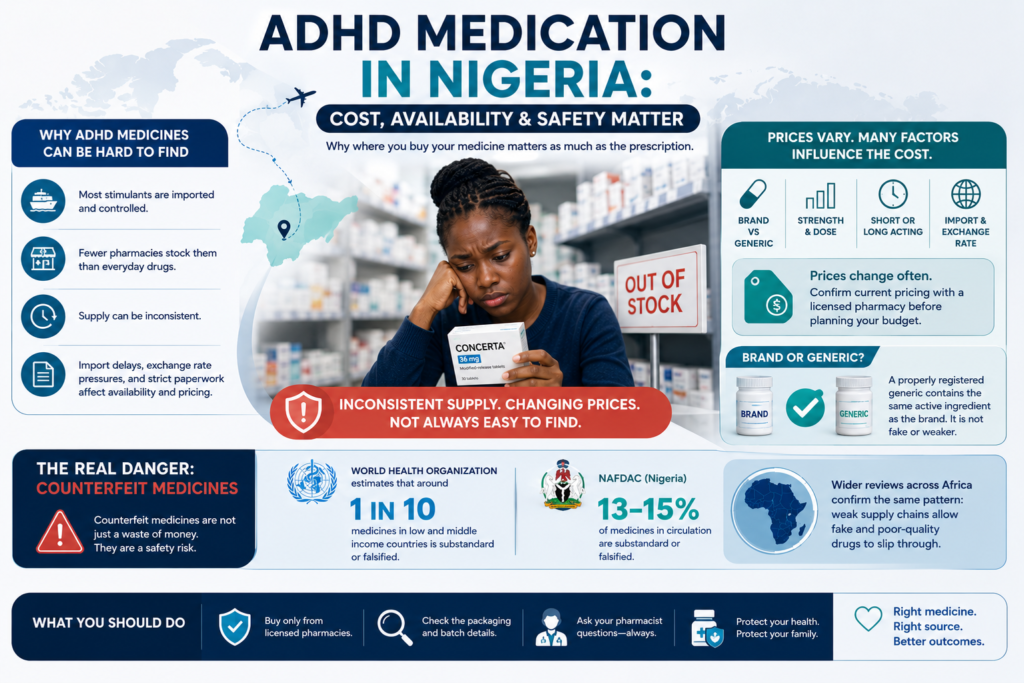
This is where many Nigerian families hit a wall. ADHD medicines are not always easy to find here, and the reasons are worth understanding.
Most ADHD stimulants are imported and controlled, so far fewer pharmacies stock them than stock everyday drugs. Supply can be inconsistent. A pharmacy that has Concerta this month may run out next month because of import delays, foreign exchange pressure on pricing, or the strict paperwork that controlled medicines require.
Prices vary widely and change often, so any fixed figure you see online today may be wrong tomorrow. What drives the price is the brand versus generic choice, the strength, whether it is short or long acting, and current import and exchange rate conditions. Rather than quote a number that could mislead you, the honest guidance is to confirm current pricing directly with a licensed pharmacy before you plan your budget.
On brand versus generic, clear up one fear. A properly registered generic contains the same active ingredient as the brand and is not fake or weaker. The real danger is not generics. It is counterfeits.
And that danger is not small. The World Health Organization estimates that around 1 in 10 medicines circulating in low and middle income countries is substandard or falsified, and Nigeria’s own regulator, NAFDAC, has said between 13 and 15 percent of medicines in circulation fall into that group. A wider review of the problem across Africa found the same pattern of weak supply chains letting fake and poor-quality drugs slip through.
For a controlled medicine that affects the brain and the heart, a counterfeit is not just a waste of money. It is a safety risk. This is exactly why where you buy your ADHD medication matters as much as the prescription itself.
Common Myths About ADHD Medication
Myth: ADHD medicine is a hard drug that will turn my child into an addict.
Reality: Prescribed at the correct dose and monitored by a professional, the risk of addiction is low. Stimulants are controlled because they can be misused if taken wrongly, but used as directed under supervision, they are considered safe.
Myth: The medicine will change my child’s personality and make them a zombie.
Reality: The right dose helps a child become more themselves, calmer and more focused, not blank. A flat, “zombie” feeling usually means the dose is too high and needs adjusting, not that the medicine is wrong.
Myth: You can just buy ADHD medicine over the counter like painkillers.
Reality: Stimulant ADHD medicines are controlled and prescription only. Anywhere selling them freely without a prescription should raise a serious red flag about whether the product is genuine.
Myth: If the medicine works, my child will be stuck on it for life.
Reality: Treatment is reviewed regularly. Some people take it for years, others reduce or stop as they grow and learn coping skills. It is a plan you revisit, not a life sentence.
Myth: Prayer, herbs, or a special mixture can replace the medicine.
Reality: Faith and a healthy lifestyle support wellbeing, and nobody is telling you to abandon them. But no herbal concoction has been proven to treat ADHD, and unregulated mixtures can be unsafe. Evidence-based care and your beliefs can walk together.
Medication Management
This is the section that decides whether treatment succeeds or quietly fails.
Why adherence matters. ADHD medicine only helps on the days it is actually taken correctly. Skipping doses, taking them at random times, or stopping suddenly because symptoms improved all reduce the benefit. Consistency is the quiet hero of good outcomes.
Common mistakes to avoid. Stopping the moment things get better. Doubling up after a missed dose to “catch up.” Sharing medicine with a sibling or friend who “seems the same.” Buying refills from an unfamiliar source because it is cheaper. Judging a non-stimulant as a failure after only a few days.
Missed doses. As a general rule, a forgotten dose is usually skipped rather than doubled, but the safe answer depends on the specific medicine and time of day. Ask your pharmacist what to do for your exact medication so you have a clear plan before it happens.
Safe storage. Keep ADHD medicines in a cool, dry place, out of direct heat and humidity, and firmly out of the reach of children and anyone they are not prescribed for. Because stimulants are controlled, secure storage is both a safety habit and a legal responsibility.
Follow-up and monitoring. Keep your review appointments even when things are going well. Watch for changes in sleep, appetite, mood, or heart symptoms, and write them down so you can report them clearly.
When to contact your healthcare provider. Reach out promptly for chest pain, fainting, a racing heartbeat, severe mood changes, or any reaction that worries you. You never need a “big enough” reason to ask a question about a controlled medicine.
Where a pharmacist fits in. A good pharmacist is more than a person who hands over a box. They confirm your medicine is genuine, explain how to take it, flag interactions with other drugs you use, help you handle side effects, and keep you supplied so treatment never breaks midstream.
This is the role HubPharm Africa plays for families managing ADHD. Our pharmacists help patients access genuine, verified ADHD medication, offer guidance on safe use, and can assist in sourcing prescribed medicines, including ones that may not currently appear on our website, since many ADHD medicines are controlled and handled directly through our pharmacist line. If you have a prescription and you are struggling to find your medicine or unsure whether what you found is real, you can send us the details on WhatsApp, call +234 705 050 5001, or reach us through hubpharmafrica.com, and a pharmacist will guide you.
ADHD medicines should only be used under professional guidance. Nothing in this article is a substitute for advice from your doctor or pharmacist.
Simple Ways to Protect Your Health Starting Today
- Keep a simple daily reminder, on your phone or a wall chart, so doses are never guessed.
- Store medicines in a cool, dry, locked place away from children.
- Buy only from a licensed pharmacy and check the packaging.
- Keep every follow-up appointment, even on good days.
- Track sleep, appetite, and mood in a small notebook to share at reviews.
- Never share ADHD medicine with anyone, even family who “have the same thing.”
- Ask your pharmacist one question you have been unsure about. That is what they are there for.
- Pair the medicine with routine, exercise, and support, not medicine alone.
Frequently Asked Questions
What is the most common ADHD medication? Methylphenidate, often known by the brand name Ritalin and its long-acting version Concerta, is the most commonly prescribed ADHD medicine worldwide. It is a stimulant that helps improve focus and calm hyperactivity.
Do ADHD medications work immediately? Stimulants often start working within 30 to 60 minutes, so the effect is quick. Non-stimulants like atomoxetine are different and can take several weeks to reach full benefit, so they need patience.
Are ADHD medications safe for children? Used at the correct dose and monitored by a professional, they are considered safe and effective for many children. For children under six, experts recommend behaviour therapy first before trying medicine.
Can adults take ADHD medication? Yes. ADHD does not disappear at 18. Many adults use the same classes of medicine to improve focus, follow-through, and impulse control at work and at home.
Is ADHD medication addictive? When taken as prescribed and supervised, the risk of addiction is low. Stimulants are controlled substances because they can be misused if taken incorrectly, which is exactly why professional guidance and genuine sourcing matter.
Why is ADHD medication hard to find in Nigeria? Most ADHD stimulants are imported and controlled, so fewer pharmacies stock them, and supply can be affected by import delays, pricing pressure, and strict regulations. A licensed pharmacy can help you locate genuine stock.
Can I stop ADHD medication once symptoms improve? Not on your own. Improvement often means the medicine is working, not that it is no longer needed. Any change should be planned with your prescriber, who may adjust, pause, or gradually reduce it.
The Takeaway
ADHD medication can be life-changing, but it is one instrument in a bigger orchestra. The tablet steadies focus. The skills, routines, support, and follow-up carry the rest. Get both right and you give a child or adult with ADHD a real shot at thriving, not just coping.
If you are just beginning this road, breathe. You do not have to understand everything at once, and you do not have to figure out sourcing alone. Genuine medicine, an honest pharmacist, and a steady plan make the difference.
Our next article, Living Successfully with ADHD: Practical Strategies for Children, Adults and Families, picks up exactly where the medicine leaves off, with the everyday tools that turn good treatment into a good life.
Author
Kelvin is a Physiology graduate from the prestigious University of Ilorin, with a background spanning health science, therapy, and health communications. As Content creation Lead at HubPharm Africa, he brings a science-informed perspective to making health information accessible, accurate, and engaging. You can share your perspectives and/or feedback with Kelvin at kelvin@hubpharmafrica.com