Haemophilia in Nigeria: Only 3 Percent Are Diagnosed
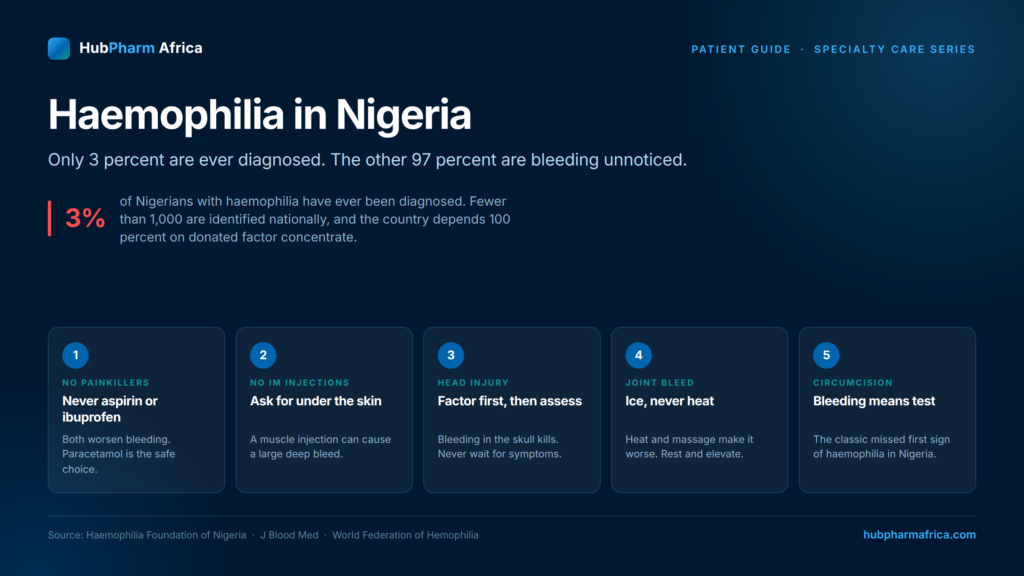
Haemophilia in Nigeria is not rare. It is unfound. Roughly one boy in every 5,000 is born with haemophilia A and one in 10,000 with haemophilia B, which across a population of over 200 million means tens of thousands of people. Fewer than 1,000 have ever been identified.
That is about 3 percent. The other 97 percent are somewhere in the country, bleeding into their joints, being told they are clumsy, or dying of injuries that would not kill anyone else.
Haemophilia in Nigeria is therefore mostly a detection problem rather than a treatment problem. This guide is for the families in that 97 percent, and for the ones already diagnosed and struggling to keep treatment supplied. It covers what to look for, what treatment actually exists here, and the five mistakes that turn a manageable condition into a fatal one.
What the numbers say about haemophilia in Nigeria
The diagnosis gap is not uniquely Nigerian, but Nigeria sits at the wrong end of it.
| Region | Share of expected cases diagnosed |
| Europe | 81 percent |
| The Americas | 54 percent |
| Africa | about 8 percent |
| Nigeria | about 3 percent |
Worldwide, of an estimated 815,100 people with haemophilia, only 347,026 have been diagnosed. Africa uses less than 0.1 international units of clotting factor concentrate per head of population, which is a rounding error against what treatment actually requires.
Two things happened in 2026 worth knowing about. Nigeria launched its first National Bleeding Disorders Registry on 23 April, at World Haemophilia Day in Abuja, alongside a programme called Road to Clot. That matters because you cannot supply a population you have never counted.
And the country’s supply position was stated plainly by Megan Adediran of the Haemophilia Foundation of Nigeria: Nigeria depends 100 percent on donated products. In her words, “If there is no donation and a child is bleeding, we have nothing to offer.”
Hold that sentence in mind, because it explains why this article spends as much time on cheap adjuncts and avoidable mistakes as it does on factor concentrate.
What haemophilia is, in plain terms
Blood clots through a chain of proteins called clotting factors. In haemophilia one of those proteins is missing or not working, so bleeding carries on far longer than it should. The blood is not thin and it does not bleed faster. It bleeds for longer, and it fails to hold the clot once formed.
The two types
Haemophilia A is a deficiency of factor VIII and accounts for the large majority of cases. Haemophilia B, sometimes called Christmas disease, is a deficiency of factor IX. They look identical from the outside but need different products, which is precisely why a laboratory diagnosis matters more than a clinical guess.
Von Willebrand disease is a separate and considerably more common bleeding disorder, affecting men and women equally. It usually causes nosebleeds, easy bruising, heavy periods and prolonged bleeding after dental work rather than the deep joint bleeds of haemophilia.
Severity is measured, not guessed
Severity depends on how much working factor is present.
| Level | Factor activity | What it usually means |
| Severe | Below 1 percent | Spontaneous bleeds, often into joints, from infancy |
| Moderate | 1 to 5 percent | Bleeding after minor injury, occasional spontaneous bleeds |
| Mild | 5 to 40 percent | Bleeding mainly after surgery, dental work or serious injury |
Mild haemophilia in Nigeria goes missed for decades and often surfaces during surgery, which is one of the more dangerous ways to find out.
Women and girls are affected too
The gene sits on the X chromosome, so haemophilia appears mostly in boys. But mothers, sisters and daughters who carry the gene can have low factor levels themselves, and some bleed as much as a man with mild haemophilia. Heavy periods that soak protection hourly, or leave a woman anaemic, deserve investigation rather than dismissal.
The old habit of calling these women “just carriers” has cost a great many of them appropriate care.
How haemophilia in Nigeria usually announces itself
Very few Nigerian families receive a diagnosis at birth, so the condition shows itself through events that get explained away.
Bleeding after circumcision
This is the single most important paragraph in the article for a Nigerian reader.
Prolonged or repeated bleeding after circumcision is a classic first presentation of haemophilia, and it happens in a country where almost every boy is circumcised, usually in the first weeks of life. When bleeding continues for hours, restarts after it seemed to stop, or needs repeated attention, the correct response is a clotting test, not a tighter dressing.
If that happened in your family, to any boy, at any point, get the test.
Bruising that does not match the child
Large, lumpy bruises from ordinary crawling and toddling, often with a hard swelling under the skin. Parents hear that the child is clumsy. Worse, some families face suspicion of harming the child, a particular cruelty when the real answer is a blood test.
Joint bleeds
The hallmark of moderate and severe haemophilia. Blood collects inside a knee, ankle or elbow, and the joint becomes hot, swollen, painful and held bent. Children often describe an odd tingling or bubbling in the joint before the pain arrives, which is the moment treatment works best.
Repeated bleeds into the same joint destroy it. That is how young men end up with the stiff, wasted, painful joints that make haemophilia visible from across a room, and it is entirely preventable with adequate treatment.
Other patterns worth acting on
Prolonged bleeding after dental extraction, after the umbilical cord separates, from the mouth or tongue after minor injury, or blood in the urine. Any of these in combination with a family history on the mother’s side should send you for a test.
What treatment for haemophilia in Nigeria actually looks like
Factor replacement
The core treatment is replacing what is missing, factor VIII for haemophilia A and factor IX for haemophilia B, given intravenously. Given promptly, a bleed that would have taken a joint stops within hours.
Internationally the standard of care is prophylaxis, meaning regular scheduled infusions to prevent bleeds rather than treating them after the damage starts. Most Nigerian patients receive on demand treatment instead, meaning factor only when a bleed has already begun, and only when product is available.
There is an important middle path. Published work in resource limited countries supports low and intermediate dose prophylaxis, using smaller amounts more thoughtfully, which reduces both joint damage and the risk of developing inhibitors. It is worth raising with a haematologist rather than assuming prophylaxis is out of reach.
Emicizumab, and why it matters here more than anywhere
Emicizumab is not a clotting factor. It is an antibody that mimics the job factor VIII does, and it has three properties that suit Nigeria unusually well.
It goes under the skin, not into a vein, so it needs no cannula and no infusion visit. It comes weekly or less often rather than several times a week. And it works in people who have developed inhibitors, meaning antibodies that make ordinary factor VIII stop working, which affects a substantial minority of severe haemophilia A patients.
Access is expanding through the World Federation of Hemophilia’s Humanitarian Aid Program. It is not universally available here, and it treats haemophilia A only. But any Nigerian family being told there is nothing beyond waiting for donated factor should ask about it specifically.
The cheap things that are always worth having
Two medicines cost a fraction of factor concentrate, are widely available in Nigeria, and are consistently underused.
Tranexamic acid helps hold a clot in place once formed. It is particularly useful for bleeding from the mouth, nose, gums and after dental work, and it is a sensible thing for a haemophilia family to keep at home after discussing dosing with a pharmacist. It does not replace factor for joint or deep bleeds.
Desmopressin, or DDAVP, releases the body’s own stored factor VIII. It works in mild haemophilia A and in many people with von Willebrand disease, and does nothing at all in haemophilia B or severe haemophilia A. A test dose establishes whether it works for a particular person, so ask whether you have ever had one.
Five mistakes that make haemophilia in Nigeria more dangerous
1. Aspirin and anti-inflammatory painkillers. Aspirin, ibuprofen and diclofenac all interfere with platelets and worsen bleeding. For pain, paracetamol is the safe first choice. This mistake is made constantly, because these are the drugs sold on every street.
2. Injections into muscle. An intramuscular injection can cause a large, deep bleed. Ask for vaccines and other injectables under the skin where possible, with a fine needle and firm pressure afterwards. Tell every nurse and every vaccinator, every time.
3. Waiting to see how a head injury develops. Bleeding inside the skull is the commonest cause of death in haemophilia and it can follow a knock that looked trivial. The rule is factor first, then assessment, and never the reverse. Do not wait for symptoms.
4. Treating a joint bleed at home with heat or massage. Heat and rubbing increase bleeding. Rest, ice, gentle compression and elevation, plus factor as early as possible, is the correct response.
5. Reaching a diagnosis and then losing the supply. A family that finally gets a diagnosis and then cannot obtain product reliably is back where it started. This is the failure HubPharm exists to address, and it is a logistics problem rather than a medical one.
When to go to hospital immediately
Treat these as emergencies, and give factor first if you have it and know how.
- Any head injury, however minor it looked, or headache, vomiting, drowsiness or confusion afterwards
- Swelling of the neck, throat or mouth, or difficulty breathing or swallowing
- Severe abdominal, groin or hip pain, which can indicate a deep muscle bleed
- Blood in the urine or stool, or vomiting blood
- Any bleed that will not stop, or a joint bleed not improving after treatment
- Injury to the eye
Carry your diagnosis in writing. In a Nigerian emergency department, a card or letter stating the type and severity of haemophilia changes what happens in the first hour.
Common questions
Can haemophilia in Nigeria be cured?
Not currently, though gene therapy exists internationally for some patients and is not yet accessible here. What is achievable now is prevention of bleeds and protection of joints, which changes a life entirely.
How is it diagnosed?
A clotting screen followed by a specific factor assay to identify which factor is deficient and at what level. Genetic testing is available in some centres. A clinical impression is not enough, because haemophilia A and B need different products.
Is it always inherited?
Usually, but roughly a third of cases arise from a new mutation with no family history at all. The absence of affected relatives does not rule it out.
Can someone with haemophilia play sport or work normally?
With adequate treatment, yes, and physical strength protects joints. Swimming and cycling are excellent. Contact sports are the ones to avoid. The aim is a full life with sensible precautions, not a life spent sitting down.
What about von Willebrand disease?
It is far commoner than haemophilia and often milder, and it affects women and men equally. Heavy periods are the commonest presentation in women. Treatment often involves desmopressin and tranexamic acid rather than factor.
Does haemophilia in Nigeria shorten life expectancy?
Without treatment, severely. With reliable factor supply and prompt treatment of bleeds, people live a normal span. Almost every year lost here is lost to supply and delay rather than to the condition itself.
Where do I even start in Nigeria?
Ask for a referral to a haematologist at a teaching hospital, and contact the Haemophilia Foundation of Nigeria, which supports families and works with the treatment centres. Getting on the national registry matters, because supply planning follows the count.
The 97 percent is the whole problem
Everything difficult about haemophilia in Nigeria follows from that diagnosis gap. Undiagnosed patients cannot be counted, uncounted patients cannot be planned for, and unplanned supply means a country dependent entirely on donation.
HubPharm Africa works on the part of that chain we can affect. Our specialist sourcing team pursues factor concentrates and other rare disease medicines through verified channels, handles cold chain where products require it, and coordinates supply so that treatment does not lapse between crises. We will tell you honestly what we can and cannot obtain, because a family in the middle of a bleed deserves an accurate answer rather than a hopeful one.
Haemophilia in Nigeria is survivable and manageable, and the barrier is logistics rather than medicine. If someone in your family bleeds in a way nobody has ever explained, start with the test. If you already have a diagnosis and the supply keeps failing, talk to us.
[Talk to a HubPharm pharmacist →]
⸻
Written by Fawzi Rufai, Medically reviewed by Pharm. Sesan Kareem, B.Pharm, MPA, MBA.
This article is for general information and does not replace advice from your own haematologist. Never delay emergency treatment for a suspected bleed in order to read anything, including this page.
References
- Federal Ministry of Health, Nigeria, National Bleeding Disorders Registry launch, World Haemophilia Day, April 2026, as reported in The Guardian Nigeria.
- Optimizing Haemophilia Care in Resource-Limited Countries: Current Challenges and Future Prospects. Journal of Blood Medicine.
- World Federation of Hemophilia, Humanitarian Aid Program.
- World Federation of Hemophilia, Guidelines for the Management of Hemophilia.
- Improving access to hemophilia care in sub-Saharan Africa by capacity building. Blood Advances.
- Low-dose emicizumab for more equitable access to prophylaxis in resource limited countries. Haemophilia, 2024.