Psoriasis in Nigeria: Treatment Beyond Creams and Soaps
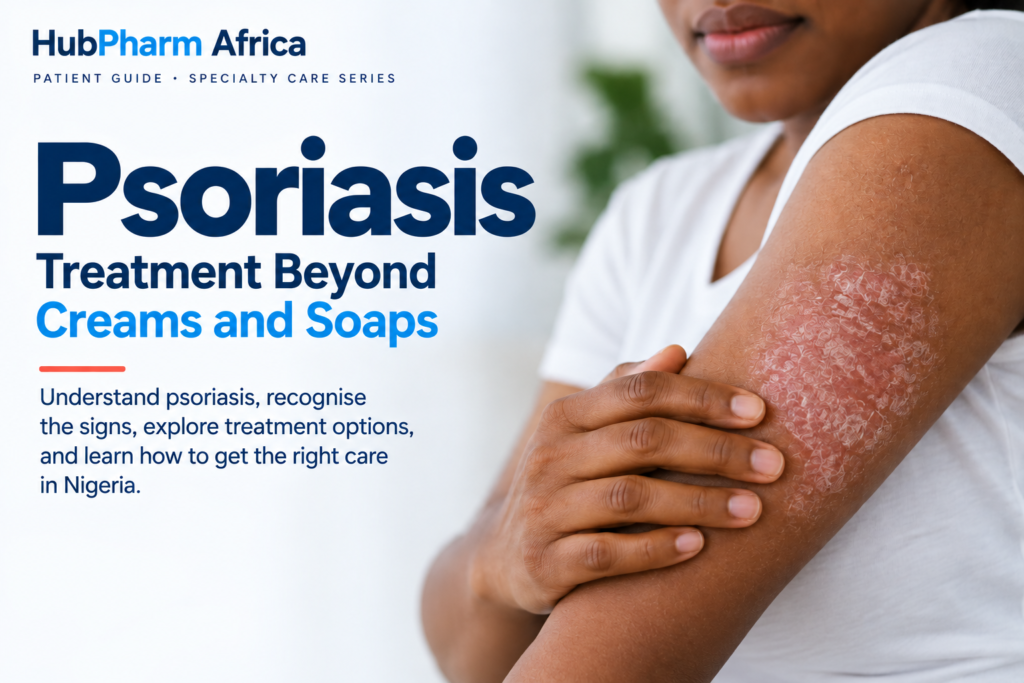
Psoriasis is more than a dry or itchy skin condition. It is a chronic inflammatory disease that can affect the skin, nails and joints, and it can have a significant effect on daily life.
In Nigeria, psoriasis can also be misunderstood. A person with scaly patches may first try soaps, creams or home remedies for months without receiving a clear diagnosis. Older Nigerian studies found psoriasis among a small proportion of patients attending dermatology clinics, while more recent researchers have highlighted the need for better Nigerian data and a dedicated psoriasis registry.
The good news is that psoriasis can be treated. The right treatment depends on the type and severity of psoriasis, where it appears on the body, how much it affects your life, and whether your joints or other health conditions are involved.
What is psoriasis?
Psoriasis is an immune-mediated inflammatory disease. The immune system becomes overactive and causes skin cells to build up much faster than normal.
Instead of the usual gradual turnover of skin cells, new cells reach the surface too quickly. This can produce thickened, raised or scaly patches that may itch, crack or become uncomfortable.
Psoriasis can affect different parts of the body, including:
- Scalp
- Elbows and knees
- Lower back
- Hands and feet
- Nails
- Skin folds
- Other areas of the body
It is not contagious. You cannot catch psoriasis from touching someone who has it.
Psoriasis is also not simply a cosmetic problem. Modern clinical guidance describes it as a chronic, multisystem inflammatory disease, and people with psoriasis may have associated conditions including psoriatic arthritis, cardiovascular disease, metabolic problems and mental-health concerns.
What does psoriasis look and feel like?
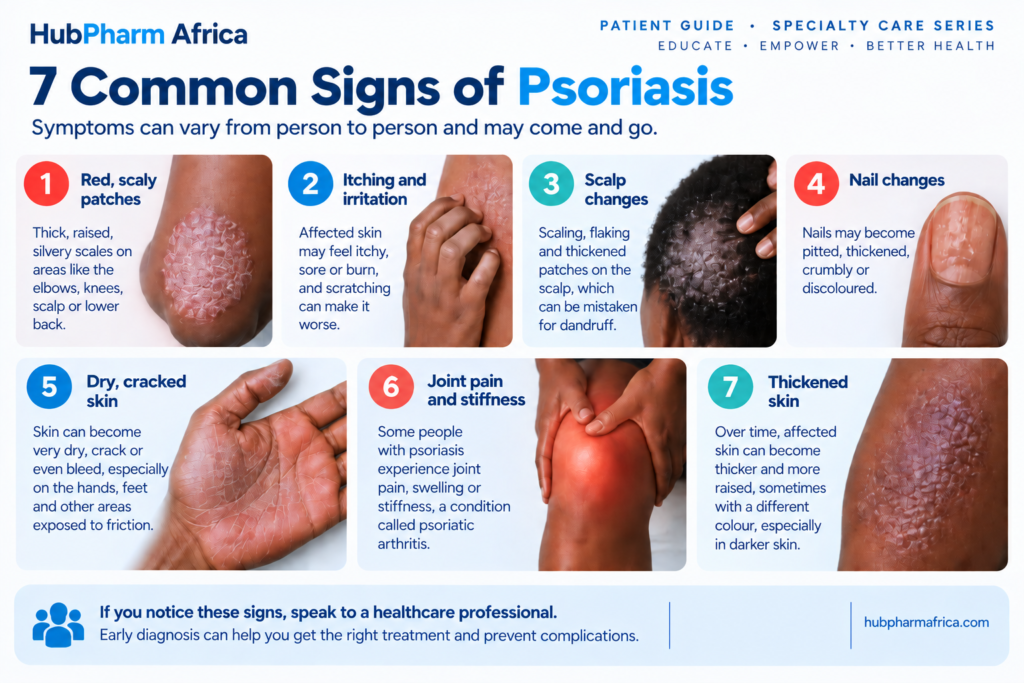
The appearance varies from person to person and can also vary with skin tone.
Common features include:
Thick, scaly patches
Plaque psoriasis, the most common form, typically produces raised areas of inflamed skin covered with scale.
Itching and irritation
Some people experience considerable itching, burning or soreness. Scratching can make affected skin more uncomfortable.
Scalp changes
Psoriasis can affect the scalp and may produce scaling that can sometimes be mistaken for ordinary dandruff.
Nail changes
The nails may develop pits, thickening, separation from the nail bed or changes in colour.
Cracked or painful skin
Psoriasis affecting the hands, feet or other areas exposed to friction can interfere with everyday activities.
Importantly, psoriasis does not look identical in every person. In darker skin, redness may be less obvious and the affected areas may appear darker, violaceous or otherwise different from the classic textbook images often shown online.
Why psoriasis in Nigeria can be difficult to recognise
There is still limited Nigerian epidemiological information about psoriasis.
A 2024 report describing the development of Nigeria’s first psoriasis registry noted that African prevalence estimates are lower than those reported in many Western populations and suggested that underdiagnosis or misdiagnosis may contribute to the difference.
Older Nigerian studies found psoriasis in approximately 0.6–0.8% of new dermatology patients in particular hospital settings. These figures should not be interpreted as the prevalence of psoriasis in the Nigerian population, because they came from selected clinical populations rather than national community surveys.
This distinction matters.
Nigeria needs better population-level data before anyone can responsibly state exactly how many Nigerians have psoriasis.
For patients, however, the practical message is simple: persistent scaly or inflamed skin deserves proper assessment rather than endless experimentation with different creams and soaps.
Psoriasis is not the same as eczema or a fungal infection
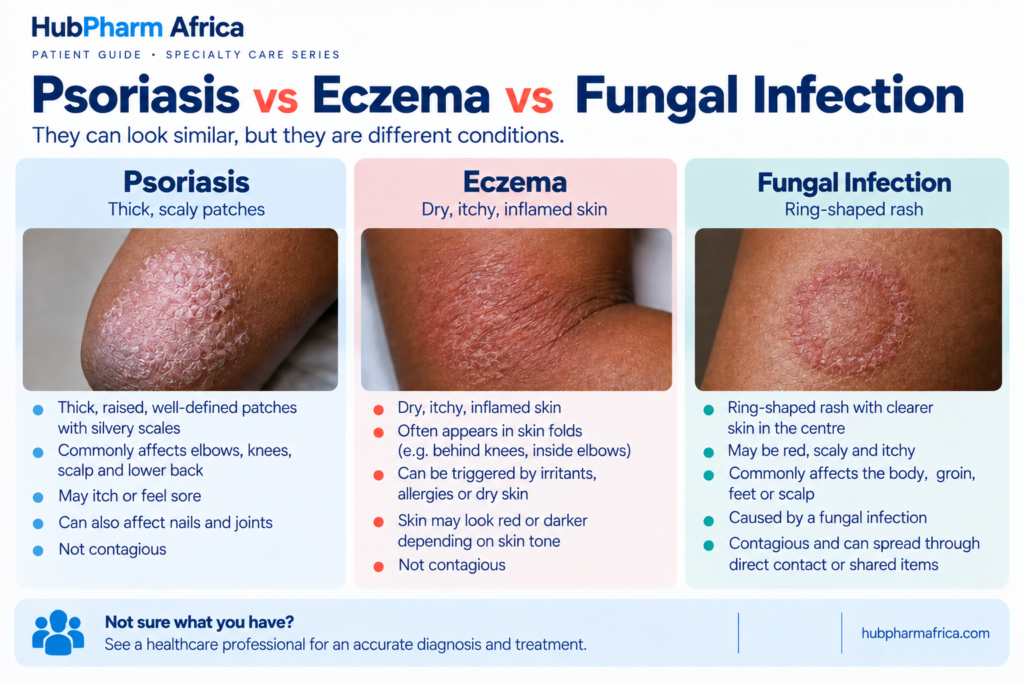
Several skin conditions can look similar.
Psoriasis may be confused with:
- Eczema or dermatitis
- Fungal infections such as ringworm
- Seborrhoeic dermatitis
- Allergic skin reactions
- Other inflammatory skin diseases
This is one reason self-diagnosis can be difficult.
A cream that temporarily reduces itching does not necessarily mean the underlying diagnosis was correct. A healthcare professional may need to examine the distribution and appearance of the lesions and, in some cases, perform additional investigations.
Getting the diagnosis right matters because treatment differs substantially between these conditions.
Can psoriasis be cured?
At present, psoriasis is generally considered a long-term condition rather than something that can simply be cured permanently.
However, treatment can control inflammation, reduce scaling and itching, improve the appearance and function of the skin, and help prevent complications.
Some people experience periods when their psoriasis becomes much less active or disappears temporarily. Others require ongoing treatment to maintain control.
There is no single treatment that works for everyone. Dermatologists may use one treatment or combine several approaches depending on the person’s disease.
The goal is not simply to make the skin look better for a few weeks. Good treatment aims for sustained disease control and a better quality of life.
Psoriasis treatment: beyond creams and soaps
Treatment usually depends on disease severity and location.
1. Topical medicines
For many people with mild psoriasis, treatment applied directly to the skin is an important starting point.
Depending on the location and type of psoriasis, a clinician may prescribe treatments such as:
- Topical corticosteroids
- Vitamin D analogues
- Calcineurin inhibitors for selected areas
- Other scale-reducing or skin-softening treatments
Topical corticosteroids can be very effective, but stronger preparations and prolonged use need appropriate medical supervision because side effects can occur.
Moisturisers and emollients can also help reduce dryness and discomfort. However, moisturiser alone does not treat the underlying inflammation of psoriasis.
2. Phototherapy
When topical treatment is not enough, controlled exposure to specific types of ultraviolet light may be considered.
Phototherapy is different from simply spending more time in the sun.
It is administered according to a treatment plan, with appropriate equipment and monitoring. It can be useful for some people with more extensive psoriasis.
3. Systemic medicines
When psoriasis is extensive, significantly affects quality of life, involves difficult-to-treat areas, or does not respond adequately to topical treatment, a dermatologist may consider medicines that work throughout the body.
Examples include:
Methotrexate
Methotrexate is an established systemic treatment for moderate-to-severe psoriasis.
It requires appropriate dosing, medical supervision and monitoring because it can cause important adverse effects and is not suitable for everyone. Current dermatology guidance continues to include methotrexate among systemic treatment options.
Cyclosporine
Cyclosporine can work rapidly and may be considered in selected patients with severe psoriasis. Because of its potential effects on blood pressure, kidney function and other aspects of health, it requires careful monitoring.
Acitretin
Acitretin is an oral retinoid that can be useful for certain forms of psoriasis.
It has important restrictions and monitoring requirements, particularly concerning pregnancy. It should therefore only be used under appropriate specialist supervision.
Apremilast
Apremilast is another systemic option for selected adults with moderate-to-severe psoriasis. Its suitability depends on the individual patient and clinical circumstances.
What about biologic medicines?
For some people with moderate-to-severe psoriasis, biologic medicines can provide substantial disease control when other treatments are insufficient or unsuitable.
Biologics target specific parts of the immune system involved in psoriasis.
Examples include medicines targeting:
- TNF
- IL-17
- IL-12/23
- IL-23
Examples of biologic medicines used internationally for psoriasis include adalimumab, etanercept, infliximab, ustekinumab, secukinumab, ixekizumab, guselkumab and risankizumab. The appropriate medicine depends on the individual patient and local regulatory and clinical considerations.
Biologics are not automatically the next step for everyone. A dermatologist considers disease severity, previous treatments, other medical conditions, psoriatic arthritis and safety factors before selecting one.
Before certain biologic treatments, patients may require blood tests and infection screening.
Psoriasis and tuberculosis: an important Nigerian consideration
This deserves particular attention in Nigeria.
Some psoriasis biologics, especially TNF inhibitors, can increase the risk of tuberculosis reactivation in people with latent TB infection. This is why TB assessment has traditionally been an important part of evaluating patients before TNF-blocking treatment.
However, the evidence and recommendations are becoming more specific for newer biologics.
A 2025 joint position statement from the National Psoriasis Foundation and International Psoriasis Council concluded that routine latent-TB testing is not required for every patient receiving IL-17 or IL-23 inhibitors, while noting that testing may still be considered in people living in TB-endemic settings or those receiving additional immunosuppression.
For Nigerian patients, this means the decision should be individualised rather than applying one TB-testing rule to every biologic.
Your dermatologist or other specialist should determine which screening is appropriate before treatment.
Psoriasis can affect the joints
One of the most important things people with psoriasis should know is that skin disease and joint disease can occur together.
Psoriatic arthritis can cause:
- Joint pain
- Joint swelling
- Morning stiffness
- Pain where tendons attach to bone
- Swelling of an entire finger or toe
- Back pain or stiffness in some patients
Do not assume that joint pain is simply part of getting older or unrelated to psoriasis.
A 2024 Nigerian study of 60 people with biopsy-confirmed psoriasis found that 15 participants, or 25%, met classification criteria for psoriatic arthritis. The researchers concluded that psoriatic arthritis may not be rare among Nigerian psoriasis patients and recommended multidisciplinary care.
This was a hospital-based study and should not be treated as a national prevalence estimate. Nevertheless, it highlights an important clinical message: people with psoriasis should be asked about joint symptoms.
When should someone with psoriasis see a specialist?
Consider professional assessment if:
- Your rash keeps returning.
- You have persistent scaly patches.
- Your scalp symptoms do not improve with ordinary dandruff care.
- Your nails are changing.
- The condition covers large areas of your body.
- It affects your sleep, work or relationships.
- You have painful or swollen joints.
- Your current treatment is no longer controlling your symptoms.
- You are unsure whether the condition is psoriasis.
A dermatologist can help determine the diagnosis and severity and discuss treatment options.
If joint symptoms are present, rheumatology involvement may also be appropriate.
Living with psoriasis in Nigeria
Treatment is only one part of managing psoriasis.
It can also help to:
Follow the treatment plan
Psoriasis often requires consistent treatment rather than occasional treatment only when symptoms become severe.
Protect and moisturise your skin
Keeping the skin moisturised can reduce dryness and discomfort.
Pay attention to triggers
Some people notice worsening after infections, skin injury or periods of significant stress. Triggers vary, so keeping a simple symptom diary can sometimes help identify patterns.
Look after your overall health
Because psoriasis can occur alongside cardiovascular, metabolic and mental-health conditions, comprehensive healthcare is important rather than treating the skin in isolation.
Do not let embarrassment delay treatment
Psoriasis is not contagious, and having visible skin lesions does not mean someone has poor hygiene.
The condition deserves medical care—not shame.
Getting psoriasis medicine in Nigeria
Access to specialist medicines can be challenging, particularly when treatment requires medicines that need special procurement, storage or monitoring.
HubPharm’s role is to support patients and families with prescription-based medicine sourcing, subject to medicine availability, applicable requirements and professional oversight.
If you have a valid prescription for a psoriasis medicine, the appropriate approach is to provide the prescription and allow the pharmacy team to assess the available sourcing options rather than assuming that a particular medicine is immediately available.
Never start, stop or change a psoriasis medicine without guidance from your healthcare professional.
Frequently Asked Questions
Is psoriasis contagious?
No. Psoriasis is not an infectious disease and cannot be spread by touching another person.
Can psoriasis be treated?
Yes. Several treatments can control psoriasis, ranging from topical medicines and phototherapy to systemic and biologic treatments for selected patients.
Is psoriasis caused by poor hygiene?
No. Psoriasis is an immune-mediated inflammatory condition. Poor hygiene does not cause it.
Can psoriasis cause arthritis?
Yes. Psoriatic arthritis can occur in people with psoriasis. Nigerian research has shown that joint disease deserves particular attention among Nigerian psoriasis patients.
Can psoriasis go away?
Symptoms can become much less active or disappear for periods, but psoriasis is generally considered a chronic condition that may require ongoing management.
Are biologics suitable for everyone with psoriasis?
No. Biologics are generally considered for selected patients, particularly those with moderate-to-severe disease or psoriatic arthritis when other treatment approaches are inadequate or unsuitable.
The Bottom Line
Psoriasis is more than a skin problem, and treatment is more than creams and soaps.
For some people, topical treatment is enough. Others may need phototherapy, systemic medicines or biologic therapy. The right choice depends on the individual’s disease, symptoms, other health conditions and response to previous treatment.
Nigeria also needs better data on psoriasis. The creation of a national psoriasis registry is an important step toward understanding how the condition affects Nigerians and how care can be improved.
If you have persistent scaly skin, nail changes or unexplained joint pain, getting the correct diagnosis is the first step.
The goal is not simply clearer skin. It is better health, better function and a better quality of life.
References
- American Academy of Dermatology. Psoriasis: Diagnosis and treatment.
- American Academy of Dermatology. Psoriasis Clinical Guideline.
- National Institute for Health and Care Excellence. Psoriasis: assessment and management.
- American Academy of Dermatology. Psoriasis Treatment: Biologics.
- National Psoriasis Foundation & International Psoriasis Council. Joint position statement on routine testing for latent tuberculosis infection in patients with psoriasis receiving IL-17 or IL-23 inhibitors. 2025/2026.
- Journey of psoriasis registry in Nigeria (PRINCE Study). British Journal of Dermatology. 2024.
- Jacyk WK. Psoriasis in Nigerians. Tropical and Geographical Medicine. 1981.
- Psoriasis in Kaduna, North-West Nigeria: A twenty-year experience.
- Ajibade A, et al. Peculiarities of psoriatic arthritis among Nigerian psoriasis patients: a comparative cross-sectional study. Pan African Medical Journal Clinical Medicine. 2024.
- Akpabio AA, Olaosebikan BH, Adelowo OO. Psoriatic Arthritis in Nigeria: Case Series and Literature Review.Journal of Clinical Rheumatology. 2018.
- Alinaghi F, et al. Prevalence of psoriatic arthritis in patients with psoriasis: A systematic review and meta-analysis.Journal of the American Academy of Dermatology. 2018.